
Introduction
Search "hospital consultant" and you'll get two completely different career paths in your results. One is a business advisor who analyzes hospital operations. The other is a senior physician's job title used across the UK and NHS-style systems.
This mix-up trips up job seekers and hiring managers alike. Are you researching a data-driven, non-clinical strategy role, or a clinical rank that takes over a decade of medical training to reach?
The confusion isn't trivial. Management analysts, the closest U.S. occupational match to a business-side "hospital consultant," earned a median salary of $101,190 in May 2024, according to the Bureau of Labor Statistics. Getting the definition wrong could mean applying for the wrong job entirely.
This guide clears it up. We'll define both meanings of the role, break down actual day-to-day duties, map out the career path, and cover what you can realistically expect to earn.
Key Takeaways
- "Hospital consultant" means a business advisor in the U.S. but a senior physician rank in the UK/NHS
- Core work spans data analysis, compliance guidance, and strategic recommendations to leadership
- A bachelor's degree gets you started; an MHA, MBA, or MPH opens senior doors
- Pay swings widely by specialization, location, and years of experience — check current benchmarks first
What Is a Hospital Consultant?
A hospital consultant, in the U.S. business sense, evaluates hospital operations and recommends improvements to cost, efficiency, and patient care. Most come from a healthcare administration or business background rather than a clinical one.
These professionals work in one of two arrangements:
| Arrangement | How It Works |
|---|---|
| Embedded advisor | Sits on a hospital's internal leadership or strategy team, focused solely on that institution |
| External expert | Brought in by a consulting firm for a defined project, then rotated to the next client |
What separates hospital consultants from general business consultants? Clinical fluency. A hospital consultant needs to understand clinical workflows, healthcare regulations, patient-care priorities, and staffing dynamics, not just spreadsheets and process diagrams. Recommending a staffing cut that looks great on paper but slows down triage in the ER puts patient safety on the line.
Hospital Consultant vs. Consultant Physician: Clearing Up the Confusion
Here's where the title gets genuinely confusing across borders.
In the UK, NHS, and Commonwealth healthcare systems, "Consultant" is a formal clinical rank. According to the British Medical Association, Consultants are senior doctors who've completed full specialist training and appear on the GMC's Specialist Register. It's roughly equivalent to an "attending physician" in the U.S. system.
To be clear: a Consultant physician isn't "higher than" a doctor. Every Consultant is a doctor, and the title simply marks the most senior tier on the medical career ladder.
In the U.S., "consultant" almost never refers to a clinical rank. It's a non-clinical advisory professional, full stop.
What Does a Hospital Consultant Do? Key Responsibilities
Day-to-day work varies by assignment, but most hospital consultants cycle through the same core functions.
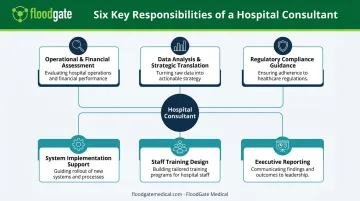
Operational and financial assessment. Consultants conduct in-depth reviews of departmental workflows and financial performance to pinpoint where money and time leak out. That often means interviewing staff, shadowing shifts, pulling reports nobody's looked at in months, and cross-checking billing codes against patient volume.
Data analysis and strategic translation. Raw operational and patient data doesn't help anyone sitting in a spreadsheet. Consultants dig into trends, then translate findings into recommendations administrators can actually act on.
Regulatory compliance guidance. Hospitals face constant pressure around reimbursement rules and payer audits. Consultants help leadership stay ahead of compliance requirements tied to standards like HIPAA and CMS reporting, reducing exposure to costly penalties.
Beyond assessment and analysis, consultants typically handle:
- System implementation support: working alongside clinical staff and IT teams to roll out EHR platforms or scheduling software
- Staff training design: building programs that help teams actually adopt new processes instead of quietly ignoring them
- Executive reporting: preparing detailed findings and presenting them to hospital boards or C-suite leadership
That last point matters more than it sounds. A brilliant analysis that never gets buy-in from a board changes nothing. Communication skills carry as much weight as analytical ones here.
Where Do Hospital Consultants Work?
Two employment models dominate this field, and they shape day-to-day life pretty differently.
In-house teams work directly within a single hospital's leadership or strategy office, focused entirely on that institution's challenges. According to Becker's Hospital Review, many health systems have built out stronger internal strategy capabilities in recent years, though they still bring in outside specialists for specific needs.
External consulting firms (think Kaufman Hall, Chartis, Guidehouse, and similar players) serve multiple hospitals, health systems, or academic medical centers on a project basis. These roles involve more travel and tighter deadlines, but expose you to a wider variety of problems.
Beyond who signs your paycheck, how long you stay on a project depends entirely on its scope:
- A diagnostic assessment might wrap in a few weeks
- An EHR implementation or strategic-plan cycle can stretch across months, sometimes with different teams handling design versus go-live
- Embedded advisory roles can run for years
There's no single "typical" timeline. Ask about project scope before you accept any offer.
How to Become a Hospital Consultant: Education, Skills & Career Path
Education Requirements
A bachelor's degree in healthcare administration, public health, or business is the standard entry point. It doesn't need to be from a specialized program: plenty of successful consultants studied general business or even engineering.
That said, senior-level positions increasingly favor graduate credentials. A master's degree such as an MHA, MBA, or MPH signals readiness for leadership-track roles, even if it's not required to break into the field.
Essential Skills
The job rewards a specific mix of hard and soft skills:
- Data analysis: spotting trends buried in operational and financial reports
- Financial acumen: understanding budgets, reimbursement models, and cost drivers
- Regulatory knowledge: staying current on healthcare compliance standards
- Project management: keeping multi-department initiatives on track
- Stakeholder communication: explaining complex findings to people who don't live in spreadsheets
That last skill often separates good consultants from great ones. Adaptability matters too: no two hospitals run the same way, and rigid playbooks fall apart fast in this environment.
Certifications That Strengthen a Candidacy
A handful of credentials carry real weight in this field:
| Certification | Issuer | Best Fit For |
|---|---|---|
| FACHE (Fellow of ACHE) | American College of Healthcare Executives | Experienced healthcare executives |
| CPHIMS | HIMSS | Health IT and information systems roles |
| CHBC | National Society of Certified Healthcare Business Consultants | Healthcare business consulting specialists |
None of these are legally required. But they signal commitment, and FACHE in particular requires five years of executive healthcare management experience, so it's a credential you build toward, not one you knock out early.
Building the Right Experience
Most consultants don't start in consulting. A more common path looks like:
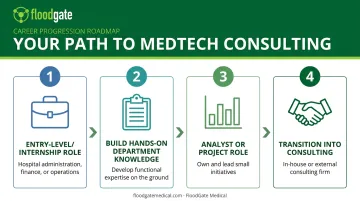
- Land an entry-level or internship role in hospital administration, finance, or operations
- Build hands-on knowledge of how departments actually function day-to-day
- Move into analyst or project roles where you start owning small initiatives
- Transition into consulting, either in-house or with an external firm
This hands-on foundation matters because you can't credibly recommend workflow changes you've never seen executed on the ground.
Many hospital consultants eventually pivot into adjacent fields, particularly medical technology and health system innovation. FloodGate Medical connects experienced healthcare operations professionals with MedTech companies that need strategic and operational expertise, whether through permanent placement or ongoing recruiting relationships.
If your background is in hospital strategy or operations, that experience translates directly to roles evaluating and improving how MedTech products fit into clinical workflows.
Hospital Consultant Salary & Job Outlook
Salary data for this role is messy, mostly because "hospital consultant" isn't a standardized job title that any single source tracks. Different platforms measure different things.
Here's what current benchmarks show for the broader "healthcare consultant" title:
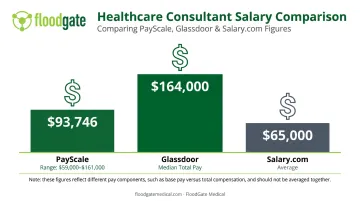
- PayScale: average base salary of $93,746, with total pay ranging roughly $59,000 to $161,000 depending on bonuses and profit-sharing
- Glassdoor: median total pay around $164,000, reflecting a broader compensation package
- Salary.com: average closer to $65,000, based on employer job postings
That spread reflects different samples and different definitions of "total pay." Don't average these numbers together. Instead, compare related titles like strategy consultant or management consultant, which tend to run higher due to broader industry demand.
For job outlook, the closest occupational proxies come from the BLS:
- Medical and health services managers: median annual wage of $117,960 in May 2024, with 23% projected growth from 2024 to 2034 — much faster than average
- Management analysts: median annual wage of $101,190, with 9% projected growth over the same period
Both figures point to healthy, sustained demand for hospital and healthcare management expertise, even though neither title maps perfectly onto "hospital consultant." Use them as directional signals, not exact benchmarks, when you're negotiating an offer. FloodGate Medical's career coaching services can help you benchmark any offer against real MedTech salary data before you sign.
Frequently Asked Questions
What is the salary for a consultant?
Pay varies significantly by specialization and experience level. According to industry salary surveys, healthcare consultant compensation ranges from roughly $65,000 to $164,000, depending on the data source and compensation components included. Check current benchmarks before negotiating.
What does a consultant do in a hospital?
A hospital consultant assesses hospital operations and financial data, then recommends strategies to cut costs, meet regulatory requirements, and strengthen patient care. They also support technology rollouts and staff training.
Is a consultant higher than a doctor?
In UK/NHS systems, "Consultant" is a senior physician rank, not a position above doctors, since every Consultant is a doctor. In the U.S., "consultant" typically refers to a separate, non-clinical business advisory role entirely.
What qualifications do I need to become a hospital consultant?
A bachelor's degree in healthcare administration, business, or public health is the typical starting point. A master's degree (MHA, MBA, or MPH) and certifications like FACHE or CPHIMS strengthen candidacy for senior roles.
What's the difference between a hospital consultant and a healthcare consultant?
"Hospital consultant" usually narrows the focus to in-patient facility operations. "Healthcare consultant" is broader, covering insurers, pharmaceutical companies, and other organizations across the healthcare industry.
How do I start a career as a hospital consultant?
Start with entry-level hospital operations or administrative experience, then pursue relevant education. Firms like FloodGate Medical specialize in healthcare and MedTech placements and can help you explore adjacent career paths.