Introduction
Scroll through any MedTech job board and you'll see "medical device" and "medical equipment" used as if they're twins. They're not. One term covers everything from a bandage to a heart valve. The other refers to the calibrated, serviced machinery that keeps hospitals running.
This isn't just semantics. The distinction determines which FDA pathway a product follows and who a company needs on staff to support it.
The stakes are high: the global medical devices market is projected to hit $604.99 billion in 2026, growing at a 6.90% CAGR through 2034, according to Fortune Business Insights. That growth means more products entering the market and lingering confusion about who's qualified to build, regulate, or service them.
This guide breaks down the difference and explains why it matters for hiring.
TL;DR
- Medical devices are FDA-regulated products, from syringes to pacemakers, used for diagnosis or treatment
- Medical equipment is a device subset needing calibration, maintenance, and trained operators, like MRI machines
- Complexity, regulatory classification, lifespan, and required expertise separate the two
- Devices need regulatory and quality talent; equipment needs biomedical and field service talent
Medical Device vs Medical Equipment: Quick Comparison
Here's the distinction at a glance:
| Category | Medical Device | Medical Equipment |
|---|---|---|
| Regulatory Classification | Governed by FDA Section 201(h); Class I, II, or III based on risk | A subset of devices with added rules for installation, calibration, and maintenance |
| Complexity & Cost | Ranges from a bandage to a pacemaker; generally lower average cost | Large, capital-intensive systems requiring significant upfront investment |
| Lifespan & Maintenance | Often single-use, disposable, or implantable | Durable and reusable, requiring ongoing servicing |
| Skills to Operate/Support | Anywhere from zero training (consumables) to specialized clinical training (implants) | Requires trained biomedical technicians or certified clinical engineers |
Every piece of medical equipment is technically a medical device. Not every medical device qualifies as equipment. A blood pressure cuff and an MRI scanner both fall under FDA's device definition, but only one requires a service contract and a certified technician to keep it running.
What is a Medical Device?
The FDA's Section 201(h) definition casts a wide net. A device is any instrument, implant, in vitro reagent, or related article intended to diagnose, treat, or prevent disease, or to affect body structure or function. It must achieve this purpose without relying on chemical action or metabolism.
That last clause matters. It's what separates a device from a drug.
The Three FDA Device Classes
Risk level determines the regulatory pathway:
- Class I – Lowest risk. About 74% are exempt from premarket notification. Nonexempt items generally need a 510(k) submission.
- Class II – Moderate risk, subject to General and Special Controls. Most require 510(k) clearance.
- Class III – Highest risk, including life-sustaining devices. These require Premarket Approval (PMA), FDA's most rigorous review.
A fourth pathway, De Novo classification, exists for novel devices with no legal predicate. It doesn't map neatly onto Class III. Instead, it creates a new Class I or II designation when general and special controls can adequately manage risk.
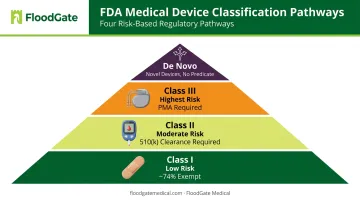
This classification structure drives everything from R&D timelines to how quickly a startup can get to market. It's also why device companies live and die by their regulatory affairs bench strength.
Use Cases of Medical Devices
The device category spans an enormous range:
- Consumables: syringes, test kits, wound dressings
- Implantables: pacemakers, stents, cardiac defibrillators
- Diagnostics: glucose monitors, at-home test kits
- Interventional tools: microcatheters used in complex coronary procedures
ASAHI's Corsair Pro and SASUKE microcatheters fall into that last bucket. Single-use, procedure-specific, and built for interventional cardiology, they illustrate how a "device" can be highly engineered without ever requiring calibration or a service contract.
Diagnostics, cardiology, orthopedics, and digital health (including software as a medical device) rely most heavily on this category. With the global market approaching $605 billion by 2026, that scale keeps regulatory and quality talent in high demand across the industry.
What is Medical Equipment?
The World Health Organization defines medical equipment as medical devices requiring calibration, maintenance, repair, user training, and eventual decommissioning, work typically overseen by clinical engineers. WHO's definition excludes implantable, disposable, and single-use devices. That's the dividing line: if it needs ongoing upkeep and trained hands to run it, it's equipment.
Two Common Categories
Per CMS guidelines, Durable Medical Equipment (DME) must withstand repeated use, last at least three years, serve a primarily medical purpose, and typically work in a patient's home. Wheelchairs and hospital beds are classic examples.
Diagnostic Equipment covers large-scale imaging and monitoring systems, such as MRI machines, CT scanners, and ultrasound units.
These aren't opposites. DME is defined by durability and home-use suitability, while diagnostic equipment is defined by clinical function. A ventilator can technically satisfy both descriptions, depending on setting.
Use Cases of Medical Equipment
Common examples include:
- MRI and CT imaging systems
- Dialysis machines
- Ventilators
- Patient monitoring systems
Hospitals, imaging centers, home healthcare providers, and rehabilitation facilities depend on this equipment daily, and someone has to keep it calibrated.
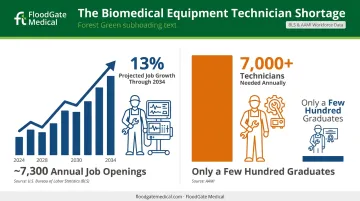
That "someone" is in short supply. According to BLS projections, medical equipment repairer jobs will grow 13% through 2034, well above average, adding roughly 7,300 openings annually.
The Association for the Advancement of Medical Instrumentation (AAMI) reports the industry needs over 7,000 additional biomedical equipment technicians every year, while academic programs graduate only a few hundred. That gap doesn't close itself.
Medical Device vs Medical Equipment: Why the Distinction Shapes MedTech Hiring
Unlike a hospital's procurement decision, the device-versus-equipment distinction mostly affects one thing: who you need to hire.
Building a Device Requires Different Talent Than Servicing Equipment
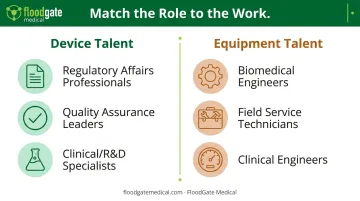
Companies building devices need:
- Regulatory affairs professionals who can navigate 510(k), De Novo, or PMA submissions
- Quality assurance leaders fluent in ISO 13485 and ISO 14971
- Clinical and R&D talent who understand design controls and predicate device strategy
FloodGate Medical recently placed a Quality & Regulatory Director at a publicly traded device company using the Aquadex SmartFlow System, an FDA-cleared fluid overload treatment technology. The role demanded 8+ years of device-specific quality experience and comfort operating in a lean, startup-style environment, exactly the profile a Class II device manufacturer needs to keep submissions moving.
Companies producing or servicing equipment, on the other hand, need:
- Biomedical engineers who design and build the systems themselves
- Field service technicians who install, calibrate, and repair equipment on-site
- Clinical engineers who manage maintenance programs and compliance documentation
AAMI has flagged unclear equipment-service responsibility as a real risk. Ambiguous ownership of maintenance duties can extend equipment downtime and create compliance headaches, exactly the kind of problem the wrong hire (or no hire) creates.
Getting the Match Wrong Slows Everything Down
Staff a device startup with equipment-focused engineers, and you'll likely see regulatory submissions stall, since the skill set for building a manufacturing-scale service program doesn't translate directly to writing a substantial equivalence argument for FDA. The reverse is just as costly: a hospital system staffing biomedical roles with device-side R&D talent risks longer equipment downtime and shakier compliance documentation.
This is where specialized recruiting earns its keep. FloodGate Medical focuses exclusively on MedTech, pairing that industry depth with a DEI-driven approach to sourcing that widens the candidate pool without sacrificing technical fit.
Whether a company needs a regulatory director who can shepherd a PMA submission or a field service technician who can keep an MRI fleet running, the goal stays the same. Match the role to the real work, not just the job title.
Building a device or supporting equipment? Connect with FloodGate Medical to find talent that fits your side of the divide.
Conclusion
There's no universal "better" option between medical devices and medical equipment. Devices cover the full spectrum of patient care tools, from disposable syringes to implantable defibrillators, while equipment represents the durable, calibrated systems hospitals depend on every day. Each category serves a specific role and demands specialized expertise to build, regulate, or maintain.
For MedTech companies and job seekers alike, correctly identifying which bucket a product falls into clarifies everything downstream: regulatory strategy, career specialization, and hiring priorities. Get that classification right, and the rest, from FDA pathway to team structure, follows naturally, whether that's a regulatory strategy or a partnership with FloodGate Medical to build the right team.
Frequently Asked Questions
What is the difference between medical devices and medical equipment?
Medical equipment is a subset of medical devices that requires calibration, maintenance, and trained operation. Medical devices broadly include everything from disposable consumables to implants and large equipment.
What is considered a medical device?
Under FDA Section 201(h), a device is any instrument, implant, or related article intended to diagnose, treat, or prevent disease without relying on chemical action in the body. Examples span thermometers to pacemakers.
What are Class III medical devices?
Class III devices carry the highest risk and typically require Premarket Approval (PMA), FDA's most rigorous review. Pacemakers and implantable defibrillators are common examples.
What are the five types of medical equipment?
Common categories include diagnostic, therapeutic, life-support, patient monitoring, and laboratory/analytical equipment. Examples range from CT scanners to infusion pumps and defibrillators.
Is a syringe a medical device or medical equipment?
A syringe is a disposable medical device, not equipment. FDA classifies it as Class II, and since it's single-use and requires no calibration, it falls outside WHO's medical equipment definition.
Do medical device and medical equipment careers require different skill sets?
Yes. Device roles lean toward regulatory affairs, quality assurance, and R&D expertise, while equipment roles favor biomedical engineering and field service skills. FloodGate Medical's recruiters specialize in matching candidates to both skill sets for MedTech employers.