
![Medical Scheduler Job Description [Updated for 2026]](https://file-host.link/website/floodgatemedical-yc9tym/assets/blog-images/692cc1a1-aabe-486c-8c34-f627625d633f/1785145458154350_2bcaf2d1c39c43d58f2b1428a008affc/360.webp)
Hiring for this role in 2026 is harder than it looks. Employers need someone who's organized, tech-savvy, comfortable with insurance jargon, and warm enough to calm an anxious patient on the phone. Many job postings miss this blend entirely.
This guide breaks down core duties, must-have skills, current salary data, and a ready-to-use job description template. We'll also cover how FloodGate Medical supports healthcare and MedTech companies building out administrative teams.
Key Takeaways
- Medical schedulers coordinate appointments, insurance verification, and patient communication across healthcare settings
- The role is projected to grow 3-4% through 2034, adding roughly 85,900 jobs nationally
- Pay typically ranges from $15 to $23 per hour, depending on experience and specialty
- Strong candidates combine organizational skills, EHR proficiency, and knowledge of medical terminology and insurance basics
What Does a Medical Scheduler Do? (Role Overview)
A medical scheduler manages patient appointments, provider calendars, and the administrative workflows that connect the two. This spans clinics, hospitals, surgical centers, and MedTech-affiliated practices running clinical trials or device evaluations.
The role isn't interchangeable with a general receptionist. A receptionist greets visitors, answers phones, and handles general front-desk tasks. A medical scheduler goes deeper:
- Interprets provider orders for diagnostic tests, surgeries, and specialist consults
- Applies working knowledge of medical terminology to book the correct service
- Navigates EHR/EMR platforms and payer-specific insurance rules
- Coordinates rooms, equipment, and staff availability for procedures, not just appointment slots
This distinction matters more as scheduling complexity grows. According to O*NET's occupational data for medical secretaries and administrative assistants, the field employed 850,000 workers in 2024, with 3-4% growth projected through 2034.
That growth includes 85,900 job openings expected over the decade, a healthier outlook than office administration roles broadly. It reflects steady demand for staff who understand clinical workflows, not just calendars.
Key Responsibilities and Duties of a Medical Scheduler
Daily duties span calendar management, patient communication, and compliance. This makes the role central to how smoothly a clinic actually runs, day to day and appointment to appointment.
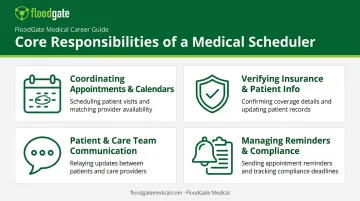
Coordinating Patient Appointments and Provider Calendars
Schedulers juggle multiple provider calendars at once. That means:
- Booking slots that match provider availability, procedure length, and room or equipment needs
- Absorbing last-minute changes without creating downstream delays
- Sequencing appointments strategically to minimize patient wait times while keeping providers fully booked
A single unfilled surgical slot can cost a facility thousands in lost revenue, which is why strategic booking ranks among a scheduler's highest-value tasks.
Verifying Patient Information and Insurance Coverage
Before a visit happens, someone has to confirm the patient is who they say they are and that insurance will actually cover the service. Schedulers:
- Collect and update demographic and insurance information
- Confirm eligibility, medical necessity, and preauthorization requirements where payers require them
- Flag out-of-pocket costs to patients before they arrive, avoiding billing surprises later
Skipping this step is one of the fastest ways to generate claim denials and frustrated patients.
Communicating with Patients and Care Teams
Scheduling demands strong communication skills alongside accuracy. Schedulers routinely:
- Walk patients through prep instructions, including fasting requirements, medication holds, and what to bring
- Relay special needs or accommodations to clinical staff ahead of visits
- Handle follow-up outreach after appointments to confirm results or next steps
Empathy and clarity matter here as much as technical precision.
Managing Reminders, Cancellations, and Compliance
No-shows remain a real problem. An MGMA poll from August 2024 found no-shows increased at 37% of surveyed medical groups, held steady at 50%, and dropped at only 13%. That's why reminder systems and waitlist management rank among a scheduler's most important daily duties.
Every task above also comes with a legal obligation: handling patient data in line with HIPAA guidelines, which functions as a built-in, non-negotiable part of the role rather than a standalone certification.
Essential Skills and Qualifications for Medical Schedulers
The strongest candidates bring a specific mix of skills, not just general office experience.
Organizational and multitasking skills. Managing overlapping calendars across multiple providers demands sharp attention to detail. One missed conflict can cascade into a full day of rescheduling.
Communication and customer service skills. Patients call while stressed, confused, or in pain. Schedulers need clear phone and email etiquette, plus the patience to de-escalate conflicts without losing efficiency.
Technical proficiency. Baseline expectations now include:
- EMR/EHR systems (Epic, eClinicalWorks, MEDITECH, or similar)
- Scheduling software specific to the practice or facility
- Microsoft Office, particularly Excel and Outlook
Medical terminology and insurance/billing basics. Schedulers need enough clinical vocabulary to interpret provider requests accurately and enough insurance knowledge to verify coverage without constant escalation to billing staff.
Education and experience benchmarks. The bar for entry-level candidates keeps rising:
- A high school diploma or GED remains the standard entry requirement
- Healthcare office experience or a certification like NHA's Certified Medical Administrative Assistant (CMAA) is increasingly preferred, especially for surgical or specialty scheduling roles
Medical Scheduler Salary and Career Outlook
Pay for medical schedulers varies by experience, facility type, specialty, and location, but current benchmarks give employers a reasonable starting range.
| Source | Average Pay | Notes |
|---|---|---|
| PayScale (2026) | $18.63/hour | Range from $15.30 (entry-level) to $23.41 (90th percentile) |
| Indeed (2026) | $19.55/hour | Based on posting-derived data |
| O*NET broader occupation | $22.08/hour / $45,930/year median | Covers the wider medical secretary category |
According to PayScale's 2026 salary data for medical schedulers, total compensation runs from roughly $32,000 to $50,000 annually, with experience being the biggest driver. Entry-level schedulers average around $15.30/hour, while those with one to four years of experience move closer to $17.86/hour.
Factors that influence pay:
- Experience level and tenure at a facility
- Facility type (hospital vs. outpatient clinic vs. specialty practice)
- Specialization, such as surgery or cath lab scheduling, which often commands a premium
- Geographic location and local cost of living
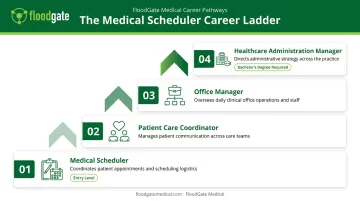
Strong performance in these areas often opens doors beyond the scheduling desk. Career progression for schedulers can lead toward patient care coordinator, office manager, or broader healthcare administration roles, particularly for those who build strong EHR and payer-relations expertise. A longer-term path into medical and health services management typically requires a bachelor's degree, so treat that as an aspirational track rather than an automatic next step.
Sample Medical Scheduler Job Description Template
Start with a short job summary that names the facility, describes the work setting, and states the purpose of the role in one or two sentences.
Example: "Our outpatient cardiology clinic is seeking a Medical Scheduler to manage patient appointments, verify insurance coverage, and coordinate closely with our clinical team to keep procedure schedules running smoothly."
Sample Responsibilities Section
- Schedule, confirm, and reschedule patient appointments, procedures, and diagnostic tests
- Verify insurance eligibility and communicate coverage details or out-of-pocket costs to patients
- Maintain accurate patient records within the EHR system
- Coordinate with clinical staff on provider availability, room assignments, and equipment needs
- Send appointment reminders and manage cancellations using waitlist protocols
- Handle patient inquiries by phone and email with professionalism and empathy
Sample Requirements & Qualifications Section
Required:
- High school diploma or GED
- 1+ years of office or customer service experience
- Proficiency with Microsoft Office and basic computer systems
Preferred:
- Prior experience in a medical office, hospital, or clinical setting
- Familiarity with EHR platforms (Epic, eClinicalWorks, or similar)
- CMAA certification or equivalent medical administrative training
Compensation, Schedule & Benefits
- Pay range: $17-$22/hour, based on experience (adjust for local market and specialty)
- Schedule: Full-time, Monday-Friday, standard clinic hours (add on-call or weekend detail if applicable)
- Benefits: Health insurance, paid time off, retirement plan matching, and continuing education support
How FloodGate Medical Helps You Build a Stronger Administrative Team
FloodGate Medical works exclusively within the MedTech industry, and that focus extends past commercial and clinical placements. Device trials, cath lab operations, and complex patient access workflows all depend on administrative staff who understand how a clinical environment actually functions, not just general office procedures.
That combination is rare: organized enough to run overlapping calendars, technical enough to work inside an EHR, and personable enough to manage anxious patients. Finding it takes a recruiting partner who understands the healthcare setting itself.
FloodGate Medical's approach centers on:
- DEI-driven sourcing that widens the candidate pool beyond traditional networks, helping teams build well-rounded staff who reflect the patients they serve
- Consultative talent mapping that identifies candidates who fit both the technical requirements and the culture of a fast-moving MedTech environment
- A specialized MedTech lens, rather than generic staffing, so hiring managers get candidates who already understand clinical terminology and workflows

If your team is building out scheduling or broader administrative support alongside clinical hiring, schedule a conversation with FloodGate Medical to talk through your staffing needs.
Frequently Asked Questions
What is the job description of a medical scheduler?
A medical scheduler coordinates patient appointments, provider calendars, and procedure bookings while verifying insurance coverage. The role also includes patient communication, reminder management, and HIPAA-compliant handling of medical records.
What are the five key steps to schedule a patient's appointment?
Scheduling follows five steps: gather patient and provider details, confirm calendar availability, verify insurance eligibility and authorization, book the appointment, then send confirmation and reminders. Each step guards against denied claims and no-shows.
What skills do you need to be a medical scheduler?
Top skills include organizational ability to manage overlapping calendars, strong phone and email communication, and technical proficiency with EHR/EMR and scheduling software. Familiarity with medical terminology and basic insurance processes complete the list of requirements.
What is the average salary of a medical scheduler?
Medical schedulers typically earn between $15 and $23 per hour, with 2026 averages around $18.63 to $19.55/hour depending on the data source. Experience, facility type, and specialty (like surgery scheduling) all affect where pay lands.
What qualifications are required to become a medical scheduler?
A high school diploma or GED is the standard baseline requirement. Healthcare office experience or a certification like CMAA is increasingly preferred, especially for roles involving surgical or specialty scheduling.
What's the difference between a medical scheduler and a medical receptionist?
Medical schedulers focus specifically on appointment coordination, insurance verification, and calendar management tied to clinical procedures. Medical receptionists handle broader front-desk duties, including greeting patients and general phone coverage, with less depth in clinical scheduling logic.
![Medical Practice Manager Job Description [Updated for 2026]](https://file-host.link/website/floodgatemedical-yc9tym/assets/blog-images/aaa27d1a-a01c-4fb8-b5f3-41b7461ce7f8/1785145357693488_9e5775b277a243ac90b133a686093465/1080.webp)