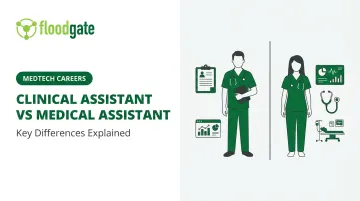
That inconsistency creates real confusion for people choosing a healthcare career path. The distinction affects which training program you pick, which certification you pursue, what your daily tasks will look like, and even where your career can go next, including pivots into specialized or industry-adjacent roles like MedTech.
This guide breaks down the duties, skills, salary data, and career trajectories tied to both titles. By the end, you'll know which path fits your interests and how either one can serve as a launching pad for something bigger.
Key Takeaways
- Medical assistants balance admin duties (scheduling, billing) with basic clinical support.
- Clinical assistants handle hands-on patient care like vitals and specimen collection.
- Training overlaps, though the CCMA certification emphasizes procedures over office tasks.
- Salary differences are minor; location and certification matter more than the job title.
Clinical Assistant vs Medical Assistant: Quick Comparison
Here's how the two roles typically stack up, based on job descriptions, certification bodies, and federal labor data:
| Category | Medical Assistant | Clinical Assistant |
|---|---|---|
| Primary Focus | Blend of administrative and clinical work | Primarily hands-on, direct patient care |
| Typical Duties | Scheduling, EHR/records management, billing support, vitals, exam prep | EKGs, phlebotomy, specimen collection, assisting with minor procedures |
| Work Environment | Primary care, family practice, general outpatient clinics | Specialty practices, urgent care, hospitals, outpatient surgery centers |
| Certification | CMA (AAMA), RMA (AMT) | CCMA (NHA), sometimes CMA as well |
| Salary Range | Median $44,200/year ($21.25/hour) nationally | Similar national baseline; varies more by state and employer type |
A few caveats matter before you lean on this table:
- The Bureau of Labor Statistics tracks only "Medical Assistants" as a formal occupation, folding clinical-focused workers into the same wage data.
- Pay varies widely by employer type: BLS data shows mean pay from $42,200 in physicians' offices to $50,250 in outpatient centers, topping $53,780 in Washington.
- Certification names (CMA, RMA, CCMA) reflect different testing bodies, not a hierarchy. None of them functions as a "higher" job title than another.
What Is a Medical Assistant?
A medical assistant (MA) is a dual-role healthcare support professional, splitting time between administrative tasks and basic clinical care. That versatility is exactly why outpatient clinics rely on MAs so heavily: one person can manage the front desk in the morning and take vitals in the afternoon.
This flexibility has direct operational value. MAs keep small practices running by managing patient flow and paperwork at the same time, reducing the need for separate front-office and clinical staff.
Common MA duties include:
- Patient check-in and appointment scheduling
- Chart maintenance and EHR data entry
- Vital signs and exam room preparation
- Basic clinical support under physician supervision
- Billing and insurance verification support
Job titles vary depending on how an employer splits responsibilities. You might see "administrative MA" or "front office MA" for roles weighted more heavily toward paperwork, even though the underlying certification and training are the same.
Where Medical Assistants Fit Best
MAs are the backbone of primary care, pediatric, and family medicine practices that need one versatile role rather than separate specialists. This is reflected in employment data: of the 811,000 medical assistant jobs in the U.S. in 2024, 61% were based in physicians' offices, according to BLS data.
A 2024 workflow study at Penn Family Care, a large academic practice, illustrates the impact well. Certified MAs were given first-pass authority over patient portal messages using existing triage protocols. The results were striking: physician-directed message volume dropped about 40%, and more than 92% of messages were resolved within two business days, up from 85% previously.
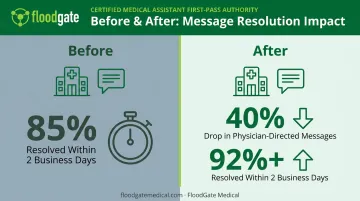
That's a real efficiency gain from giving trained MAs more responsibility instead of simply piling on tasks. Findings from the Penn Family Care study show the intervention worked at a large academic clinic; smaller independent practices may see different results depending on staffing levels.
What Is a Clinical Assistant?
A clinical assistant is centered almost entirely on direct, hands-on patient care, with little to no administrative load. Think of it as the MA role with the scheduling and billing stripped out and the procedural work turned up.
That narrower focus pays off in accuracy and safety. When one person handles EKGs, specimen collection, and injections all day rather than splitting attention with front-desk duties, procedural consistency tends to improve, particularly in high-volume clinical settings.
Common clinical assistant duties include:
- EKG administration
- Phlebotomy and specimen preparation
- Injections and medication administration (non-IV)
- Assisting physicians during minor in-office procedures
- Point-of-care testing
You'll also see the title "medical clinical assistant" or "MCA" used interchangeably with clinical assistant across training programs and job postings. There's no universal standard here. Employers define the scope, so the actual duties listed matter more than the title on the posting.
Where Clinical Assistants Fit Best
This role tends to concentrate in specialty practices, such as cardiology and OB-GYN, along with urgent care centers and hospital outpatient departments. Large systems like Mayo Clinic have posted dedicated clinical support roles for both ambulatory cardiology and urgent care.
That demand shows up in outcomes data, too. A pediatric cardiology clinic redesigned its workflow around standardized handoffs and dedicated support roles, cutting median wait time from 37 minutes to 11 minutes and improving appointment access from 103 days to 27 days.
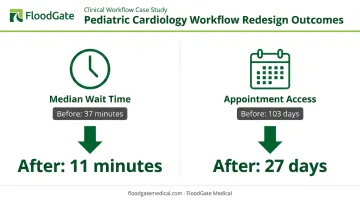
The redesign wasn't isolated to a single job title, but it shows what's possible, if imperfectly measured, when clinics invest in dedicated, procedure-focused support staff.
Clinical Assistant vs Medical Assistant: Which Path Should You Choose?
Before picking a training program, weigh these factors honestly:
- Variety vs. specialization — Do you want a mix of tasks throughout the day, or do you want to get really good at a narrow set of procedures?
- Comfort with procedures — Clinical assistant roles involve more direct exposure to blood draws, injections, and bodily fluids. If that's not for you, MA work offers more breathing room.
- Preferred setting — Primary care clinics favor generalists. Specialty practices and hospitals favor procedural specialists.
Choose medical assisting if you want a well-rounded role that bridges administrative and clinical work, with flexibility to move between tasks.
Choose clinical assisting if you want deeper, more consistent hands-on patient care exposure, especially if you're eyeing a specialty setting down the road.
Beyond personal preference, regulatory reality shapes this decision too: state scope-of-practice rules vary widely, and job titles aren't standardized. California, for example, classifies MAs as unlicensed personnel with task-specific supervision rules. Always read the actual duty list in a job posting instead of assuming what a title means.
From Patient Care to MedTech: Growing a Healthcare Career Beyond the Clinic
The skills you build as a medical or clinical assistant, taking vitals, handling specimens, supporting procedures, and communicating with anxious patients, don't stay confined to the clinic. Medical device and MedTech companies actively value that background for roles like:
- Clinical specialists
- Clinical liaisons
- Field trainers
Why? Because someone who's spent years in a cath lab or urgent care setting already understands clinical workflows and patient safety protocols, along with how procedures actually unfold under pressure. That's exactly the perspective device companies need when training physicians on new equipment or supporting product launches in the field.
The challenge is knowing how to translate that experience into a MedTech-ready resume, and finding companies that are actually hiring for it. This is where working with a recruiter who understands both sides matters.
FloodGate Medical focuses exclusively on connecting healthcare and MedTech talent with growing companies, using a DEI-driven approach to make sure candidates from varied clinical backgrounds get a fair look.

Working with a recruiter is one piece of the puzzle; staying current on where the opportunities are also helps. FloodGate Medical's monthly newsletter covers career tips and hiring insights, plus broader industry trends. It gives clinical and medical assistants a clearer sense of when it might be time to pursue a specialized, higher-paying role adjacent to direct patient care.
Frequently Asked Questions
Do clinical medical assistants get paid more than medical assistants?
Not typically. Pay differences between the two are usually small and depend far more on certification, location, and employer type than on job title.
Is a CMA higher than a MA?
No. CMA (Certified Medical Assistant) is a credential that any qualified medical assistant can earn through the AAMA (American Association of Medical Assistants). It's not a separate or higher-ranking job title.
What is a clinical assistant?
A clinical assistant is a healthcare support professional focused primarily on hands-on patient care, including vitals, specimen collection, and assisting with minor procedures.
Can a medical assistant become a clinical assistant?
Yes. Medical assistants can shift into more procedure-focused roles by earning credentials like the CCMA (Certified Clinical Medical Assistant) and building hands-on clinical experience over time.
Do you need certification to work as a clinical assistant?
Certification isn't federally mandated in most states, but many employers prefer or require it. Check your state's specific scope-of-practice rules before assuming either way.
Which role offers better long-term career growth?
Both paths can lead to nursing, healthcare administration, or specialized clinical roles like surgical technology. The better growth path depends on the certifications and experience you build, not the starting title.