
Many patients, and more than a few healthcare organizations, still default to whatever facility is closest or most familiar, even when it's the wrong fit. That mismatch has real consequences.
Rising patient volumes, a growing chronic disease burden, and the shift toward specialized and outpatient care are reshaping where and how care gets delivered. Facilities that once handled a narrow slice of care now compete with retail clinics, telehealth platforms, and surgical centers for the same patients.
This article breaks down the major types of health care facilities, what each one does best, and how patients, professionals, and organizations can think about choosing or staffing them.
Key Takeaways
- Facilities span five main types: outpatient, hospital, diagnostic, long-term, and telehealth care
- Each type differs in acuity level, staffing model, and cost structure
- Matching facility type to patient need cuts costs, wait times, and ER strain
- Growth in outpatient and diagnostic care also drives demand for specialized talent
- The right choice depends on urgency, complexity, and budget, not convenience
What Is a Health Care Facility & Why It Matters
A health care facility is any licensed location where trained professionals deliver medical, diagnostic, or therapeutic services, from a two-room family practice to a 900-bed academic medical center.
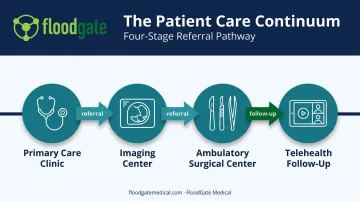
Rather than standalone categories, think of facilities as points along a connected care continuum. A patient might start at a primary care clinic, get referred to an imaging center, undergo a procedure at an ambulatory surgical center, and later receive follow-up care by video visit. Same patient, four facility types, one care journey.
This variety matters most as the U.S. population ages. The U.S. population age 65 and older hit 55.8 million in 2020, a 38.6% jump from 2010, according to Census Bureau's aging population report. Older adults typically need more of everything: routine monitoring, specialty referrals, rehabilitation, and long-term support.
Without enough facility variety to absorb that demand, the strain shows up in predictable ways:
- Emergency departments fill with patients who could have been treated at urgent care or a clinic
- Specialty treatment gets delayed because there aren't enough diagnostic or outpatient slots available
- Chronic disease management goes unmanaged when patients lack access to ongoing, lower-acuity care
Understanding what each facility type actually does, and doesn't do, is the first step toward fixing that.
Types of Health Care Facilities
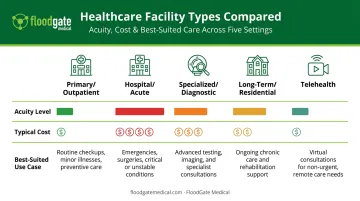
Health care facilities aren't one-size-fits-all. They're organized around scope of care, patient acuity, and setting, meaning a facility built for routine checkups looks (and staffs) nothing like one built for trauma surgery. Here's how the five major categories break down.
Primary & Outpatient Care Facilities
Physician offices, community clinics, and urgent care centers make up the front door of the healthcare system. They run on scheduled appointments and walk-ins, serving as most people's first point of contact.
Best suited for:
- Routine checkups and physicals
- Minor illness or injury, such as sprains or infections
- Chronic disease management, like diabetes or hypertension
- Preventive screenings and vaccinations
Physician offices logged 1.0 billion visits in 2019, with just over half going to primary care doctors. Urgent care has grown fast too, with more than 14,000 centers nationwide handling over 200 million visits a year.
Key strengths: cost-efficient and highly accessible, serving as a major release valve for emergency departments.
Limitations: no capacity for emergencies, surgeries, or overnight care.
Hospitals & Acute/Emergency Care Facilities
Hospitals are the only facility type built to handle anything, at any hour. Emergency departments, ICUs, surgical suites, and specialist teams operate under one roof, ready for trauma, cardiac events, or complex surgery.
The scale is enormous. U.S. hospitals recorded roughly 137 million ED visits and nearly 34 million admissions in a recent year, according to American Hospital Association data.
Best suited for:
- Serious illness or injury
- Major or emergency surgery
- Conditions involving multiple organ systems
- Situations requiring 24/7 monitoring
Key strengths: comprehensive capability, trauma readiness, immediate access to specialists, and round-the-clock staffing across disciplines.
Limitations: expensive, and often crowded. Many EDs report patients boarding for hours awaiting an inpatient bed, a sign of a system absorbing cases that didn't need hospital-level care in the first place.
Specialized & Diagnostic Care Facilities
Ambulatory surgical centers, imaging centers, dialysis facilities, and behavioral health treatment centers focus on one clinical lane and do it efficiently. Patients usually arrive by referral or self-schedule for a specific procedure or recurring treatment.
Best suited for:
- Elective procedures, like cataract surgery or joint scopes
- Recurring treatments, such as dialysis
- Diagnostic imaging and behavioral health or substance use treatment
The cost difference is significant. Medicare payment rates for procedures at ambulatory surgical centers run 46% lower than equivalent hospital outpatient department rates, per MedPAC's 2025 report to Congress. That gap is a major reason procedure volume keeps shifting away from hospitals.
Key strengths: deep specialization and faster turnaround, often at a fraction of hospital cost.
Limitations: narrow scope. These facilities aren't equipped for emergencies or patients with multi-system complications.
Long-Term & Residential Care Facilities
Nursing homes, assisted living communities, hospice programs, and continuing care retirement communities provide extended support, anything from help with daily activities to round-the-clock skilled nursing.
Best suited for:
- Elderly patients needing ongoing supervision
- Chronic or degenerative conditions
- Post-acute recovery after a hospital stay
- End-of-life and hospice care
- Short-term respite care for family caregivers
There's real range here. The U.S. has roughly 14,700 nursing homes and 32,200 residential care communities, plus around 5,800 hospice agencies serving 1.8 million patients a year.
Key strengths: continuous support, holistic and emotional care, and levels of assistance that adjust as needs change.
Limitations: cost. Medicare covers skilled nursing only up to 100 days per benefit period and won't pay for custodial care alone, a gap that surprises many families.
Telehealth & Digital Care Facilities
Telehealth swaps the physical building for a screen. Video, phone, and app-based platforms connect patients with providers remotely, using digital infrastructure instead of an exam room.
Best suited for:
- Rural or underserved patients with limited local access
- Routine follow-ups and medication management
- Mental health counseling
- Minor triage before deciding on in-person care
Adoption is substantial, even if it's leveled off. 30.1% of U.S. adults used telemedicine in 2022, down from 37% in 2021 as in-person visits rebounded, but still far above pre-2020 levels.
Key strengths: accessibility and convenience, with scalability that doesn't require added real estate.
Limitations: no hands-on exams, no equipment-based diagnostics, and no path for true emergencies.
How Facility Types Shape Healthcare Staffing and Career Paths
Every facility type needs a different mix of talent, and that mix varies dramatically by setting:
- An ER depends on trauma teams and rapid-response nurses
- An imaging center needs certified technologists
- A telehealth platform needs support staff who can troubleshoot software as easily as they handle patient intake
That mix keeps shifting. As outpatient, diagnostic, and remote-monitoring facilities expand, demand for specialized clinical and MedTech-enabled talent is climbing with it:
- Diagnostic medical sonographer roles are projected to grow 13%, adding about 5,800 openings a year
- Substance use and mental health counselor roles are projected to grow 17%, adding roughly 48,300 openings annually
- Health information technologists, who manage data across digital and diagnostic platforms, are seeing 15% growth
Overall, the Bureau of Labor Statistics projects about 1.9 million healthcare job openings annually through 2034, driven by both growth and replacement needs across clinical, technical, and administrative roles.
Demand at that scale doesn't get met by posting a job listing and hoping. MedTech and healthcare organizations staffing across primary care, hospitals, diagnostic centers, long-term care, and telehealth platforms need recruiting partners who understand how each setting actually operates.
FloodGate Medical fills that gap. The firm specializes exclusively in MedTech and medical device talent acquisition, offering permanent placement plus contract or interim staffing built around a diversity, equity, and inclusion-driven methodology.
Rather than treating every open role the same, FloodGate learns the setting, whether commercial, clinical, or operational, then builds teams suited to that specific point in the care continuum.
How to Choose the Right Type of Health Care Facility
The right facility depends on patient need, urgency, budget, and long-term goals, not proximity or familiarity. Getting this wrong costs time, money, and sometimes health outcomes.
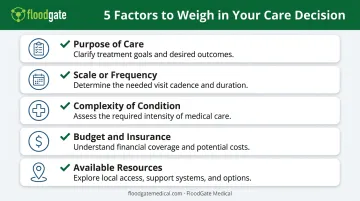
Factors to Consider
Several variables shape the right choice, and weighing them together prevents costly missteps.
- Purpose of care needed determines the entire category: preventive, acute, or long-term
- Scale or frequency matters; a one-time procedure calls for a different setting than a recurring treatment like dialysis
- Complexity of the condition dictates expertise required; unstable or multi-system issues need hospital-level care
- Budget and insurance coverage vary widely, and specialized centers often cost less than hospital-based equivalents
- Available resources, like rural access, may push patients toward telehealth or regional specialty centers
Mistakes to Avoid
Even informed patients fall into predictable traps that add cost or delay recovery.
- Defaulting to the ER for issues an urgent care center or clinic could handle just as well, at a fraction of the cost and with far less wait time
- Ignoring cost when choosing an extended care setting; Medicare's coverage limits often catch families off guard
- Choosing based on convenience rather than fit, which often means a longer road back to full recovery
Conclusion
Health care facilities exist along a continuum, not as isolated options. Primary care clinics handle routine visits, while hospitals manage critical, life-threatening cases. Specialized centers focus on specific conditions, long-term care supports ongoing needs, and telehealth extends access remotely. Each has a distinct job, and none replace the others.
Understanding these distinctions helps patients reach the right care faster. It also helps professionals map out where their skills fit best, and gives organizations a clearer basis for staffing decisions that match how care is actually delivered today.
For MedTech and healthcare organizations building teams across this landscape, that variety is exactly the challenge FloodGate Medical was built to solve. Its recruitment specialists work across the care continuum, connecting companies with the clinical, technical, and administrative talent needed to serve patients wherever that care takes place.
Frequently Asked Questions
What is an example of a health care facility?
Common examples include hospitals, physician offices, urgent care centers, ambulatory surgical centers, nursing homes, and hospice programs. Each serves a different point along the care continuum.
What are the three types of medical care?
Primary care is first-contact, ongoing care for most health needs. Secondary care involves referral-based specialist or community hospital services. Tertiary care covers highly specialized treatment, like ICU care, typically found at academic medical centers.
What's the difference between a hospital and an urgent care center?
Hospitals operate 24/7 and handle emergencies, surgery, and inpatient stays across many specialties. Urgent care centers treat non-life-threatening issues during extended, but not round-the-clock, walk-in hours at lower cost.
Is telehealth considered a type of health care facility?
Telehealth isn't a physical facility, but it functions as a care delivery channel within today's broader care network. It connects patients to licensed providers remotely, filling gaps physical facilities can't always reach.
Which type of health care facility employs the widest range of medical professionals?
Hospitals employ the broadest mix, from ER physicians and surgeons to lab technicians, pharmacists, and administrative staff, since they run multiple departments and specialties under one roof.
What should health care organizations consider when expanding into a new type of facility?
Organizations should assess patient need, staffing requirements for that specific setting, and budget realities before expanding. Partnering with a recruiter familiar with the target care setting helps avoid costly hiring missteps.
![Medical Secretary Job Description [Updated for 2026]](https://file-host.link/website/floodgatemedical-yc9tym/assets/blog-images/ffc7c265-22d6-4d39-95d7-59dd45a456e3/1785145414676453_53d552d20c524f7f901d8b062c4fe371/1080.webp)