
The common struggle: turning daily bench work, running analyzers, interpreting specimens, troubleshooting QC failures, into accomplishment statements that actually grab a hiring manager's attention. It's one thing to know your job. It's another to prove your value on paper in under 30 seconds of scanning.
This guide breaks down the full medical technologist job description, the resume sections you can't skip, a complete sample resume with real formatting examples, and the ATS and proofreading tips that get applications past the first filter. Whether you're targeting a hospital lab, a reference lab, or a diagnostics-focused MedTech company, you'll walk away with a resume that reflects your actual expertise.
Key Takeaways
- List your ASCP or AMT certification and bachelor's degree at the top of your resume.
- Quantify specimen volume, turnaround time, and accuracy rates instead of listing duties.
- Match resume keywords to the job posting to pass ATS screening reliably.
- Keep resumes one page and reverse-chronological if you have under 10 years of experience.
What Does a Medical Technologist Do? (Job Description & Work Environment)
Medical technologists, also called medical laboratory scientists or MLS professionals, analyze blood, urine, tissue, and other biological specimens to detect abnormalities that guide diagnosis and treatment. The role typically requires a bachelor's degree in medical technology, clinical laboratory science, or a related life science.
Core daily responsibilities include:
- Performing chemical, hematological, and microbiological analyses on patient specimens
- Calibrating and maintaining lab equipment, including analyzers and spectrophotometers
- Following strict quality control protocols to catch instrument drift or reagent issues before they affect results
- Documenting and reporting findings accurately in the laboratory information system (LIS)
- Troubleshooting abnormal results and flagging critical values for physician follow-up
Job growth in this field is modest. The Bureau of Labor Statistics projects employment for clinical laboratory technologists and technicians to grow 2% from 2024 to 2034, with roughly 22,600 openings expected each year, mostly from replacement needs rather than new positions. That makes a well-differentiated resume even more important in a competitive applicant pool.
Work Environment & Schedule
Most medical technologists work in one of a few settings:
- Hospitals, the largest employer segment, running 24/7 diagnostic support
- Independent reference labs processing high specimen volumes
- Physician offices performing routine, in-house testing
- Blood banks handling immunohematology and transfusion services
- Diagnostics-focused MedTech companies, increasingly hiring lab-trained talent for R&D, quality, and clinical support roles
Standard schedules run 40 hours a week, but hospitals and high-volume labs often require rotating shifts, including nights, weekends, and holidays, since specimens don't stop arriving after 5 p.m.
Medical Technologist vs. Medical Technician: What's the Difference
The two titles get confused constantly, but the distinction matters for how you position your resume.
| Factor | Medical Technologist (MLS) | Medical Laboratory Technician (MLT) |
|---|---|---|
| Education | Bachelor's degree | Associate degree |
| Testing scope | Complex, often supervisory testing | Routine testing under supervision |
| ASCP credential | MLS(ASCP) | MLT(ASCP) |
| AMT credential | MLS(AMT) | MLT(AMT) |
Technologists typically train or supervise lab staff and carry greater quality-assurance responsibility. Technicians usually work under a technologist's or lab manager's oversight. Your degree and certification are the fastest way a recruiter confirms which lane you're in, so they need to be front and center on your resume. That's exactly where the next section comes in.
Essential Sections to Include in a Medical Technologist Resume
A strong resume has six non-negotiable sections:
- Contact information — full name, phone number, professional email, LinkedIn, and city/state, placed clearly at the top
- Professional summary — a 2-3 sentence overview covering years of experience, specialization (hematology, microbiology, blood banking), and top certification
- Work experience — reverse-chronological entries with title, employer, dates, and 3-5 accomplishment-driven bullets per role
- Skills — a balanced mix of hard skills (lab techniques, LIS systems, equipment) and soft skills (attention to detail, communication)
- Education — degree, institution, and graduation year, most recent first
- Certifications & licenses — ASCP, AMT, or state licensure, with expiration dates where applicable
Skip any of these, and a recruiter has to hunt for information they expect to find instantly — a search that rarely ends well for the applicant.
Medical Technologist Resume Sample
Here's how these sections come together for a mid-level candidate. The metrics below are illustrative examples—swap in your own numbers.
Header: Jordan Mercer, MLS(ASCP) | (555) 214-8890 | jordan.mercer@email.com | linkedin.com/in/jordanmercer | Denver, CO
Professional Summary: Medical Technologist with 6 years of experience in high-volume hospital laboratories, specializing in hematology and blood banking. MLS(ASCP)-certified with a track record of maintaining 99%+ quality control compliance while processing over 150 specimens daily.
Work Experience:
Medical Technologist — Regional Medical Center, Denver, CO (2021–Present)
- Processed an average of 160 specimens daily across chemistry, hematology, and microbiology benches
- Reduced average turnaround time on stat orders by 18% through workflow adjustments with the phlebotomy team
- Maintained a 99.6% quality control pass rate across three consecutive CAP inspection cycles
- Trained four incoming technologists on LIS documentation standards and analyzer calibration protocols
Medical Laboratory Technologist — City Reference Lab, Aurora, CO (2018–2021)
- Performed complex hematology and coagulation testing supporting oncology and cardiology departments
- Identified and corrected a reagent lot discrepancy that prevented an estimated 40 inaccurate results
- Collaborated with pathologists to flag critical values, improving physician notification time by 25%
Skills: Hematology & coagulation testing, microbiology culture analysis, LIS systems (Epic Beaker, Cerner), specimen processing, equipment calibration, attention to detail, cross-functional communication, adaptability under high-volume conditions.
Education & Certifications:
- B.S. in Medical Laboratory Science, University of Colorado, 2018
- MLS(ASCP), American Society for Clinical Pathology, active through 2027

How to Write a Standout Summary and Experience Section
Your summary is prime real estate. Lead with your job title, years of experience, and specialization, then mirror language directly from the job posting instead of defaulting to generic phrases like "detail-oriented team player."
Once your summary lands, carry that same precision into your experience section, where hiring managers look for quantifiable proof. To quantify your experience, replace duty statements with measurable outcomes:
- Instead of "Performed hematology testing," try "Performed hematology testing on 80+ specimens daily with 99% accuracy"
- Instead of "Responsible for QC," try "Maintained QC compliance across three CAP inspection cycles"
- Instead of "Helped improve lab efficiency," try "Cut turnaround time by 18% through process changes"
Every bullet point should open with a strong action verb. A short reference list to pull from:
- Analyzed
- Performed
- Streamlined
- Implemented
- Calibrated
- Validated
Vary the verbs across your bullets. If every line starts with "Performed," the reader's eyes glaze over by bullet three.
Must-Have Skills & Certifications for Medical Technologists
Hiring managers scan for a specific mix of technical and interpersonal ability. Feature both.
Hard skills:
- Hematology, microbiology, and immunology testing
- Laboratory information system (LIS) proficiency
- Specimen processing and handling protocols
- Equipment calibration and maintenance
- Quality control and regulatory compliance procedures
Soft skills:
- Attention to detail
- Critical thinking under time pressure
- Clear communication with physicians and colleagues
- Adaptability across shifting priorities
- Time management in high-volume environments
Certifications to list: ASCP's MLS credential and AMT's MLS(AMT) credential remain the two most recognized in the field. ASCP retired the older "MT" designation in favor of MLS, so use current naming on your resume.
Always verify state-specific licensure requirements, too — some states require a separate clinical laboratory personnel license. FloodGate Medical recruiters flag outdated certification names as a common reason resumes get overlooked.
Formatting Tips & Final Resume Checklist
Format matters almost as much as content. A cluttered resume buries good experience.
Length and layout:
- One page for candidates with under 10 years of experience; two pages is acceptable for highly experienced professionals, according to Indeed's resume length guidance
- Reverse-chronological order, standard section headings
- Clean, simple design, skip the graphics, columns, and photo
ATS optimization matters more than most candidates realize. A 2025 Jobscan analysis found that 489 of the Fortune 500, or 97.8%, use a detectable applicant tracking system. Mirror keywords from the job description and stick to standard headings like "Work Experience" and "Education" so the software can parse your file correctly.
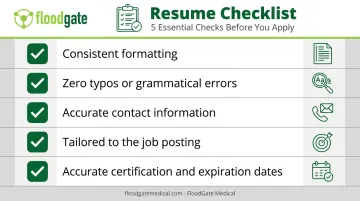
Final proofreading checklist:
- Formatting is consistent (fonts, spacing, bullet style) throughout
- Zero typos or grammatical errors
- Contact information is current and correct
- Resume is tailored to the specific job posting, not a generic template
- Certifications and expiration dates are accurate
Once your resume is polished, the next challenge is finding the right opening. That's where working with a recruiter who specializes in the medical technology space pays off.
FloodGate Medical connects candidates with MedTech companies and healthcare device manufacturers through a hiring approach built on equity and inclusion. Qualified lab professionals get considered for roles beyond what a typical job board search would surface.
Frequently Asked Questions
What is the job description of a medical technologist?
A medical technologist analyzes blood, urine, tissue, and other specimens to support physician diagnosis and treatment decisions. The role requires a bachelor's degree plus ASCP or AMT certification, with work based in hospitals, reference labs, or diagnostics companies.
What's the difference between a medical technician and a medical technologist?
Technologists hold a bachelor's degree and perform complex, often supervisory testing (MLS credential). Technicians hold an associate degree and perform routine testing under supervision (MLT credential).
How long should a medical technologist resume be?
One page works for most candidates with under 10 years of experience. Two pages is acceptable if you have extensive, directly relevant experience worth including.
What certifications should I include on my resume?
List your ASCP or AMT credential (MLS or MLT) along with any state-specific lab licensure. Include expiration or renewal dates so employers know your certification is current.
What skills are most important for a medical technologist resume?
A mix of hard skills, like diagnostic testing and equipment operation, and soft skills, like attention to detail and communication, gives hiring managers a complete picture of your fit.
Should I include a cover letter with my medical technologist resume?
Yes. A brief, targeted cover letter lets you personalize your application and explain why you're a fit for that specific lab or role. Career coaches, like those at FloodGate Medical, can help you polish both documents before you apply.