

Yet many organizations struggle to define the role clearly. Job postings blur the line between Medical Director and Clinical Director, list credentials that don't match the setting, or skip the compensation details candidates actually want to see. The result: mismatched hires, long vacancies, and frustrated hiring managers.
This guide breaks down what a Medical Director actually does, the qualifications that matter, and how to write a job description that attracts the right physician-leader — whether you're staffing a hospital floor or a MedTech clinical affairs team.
Key Takeaways
- Medical Directors must be licensed MDs or DOs, non-negotiable in regulated settings like hospice care.
- Responsibilities shift by setting: hospitals emphasize clinical governance, MedTech emphasizes safety and regulatory input.
- Credentials like CMD, CPE, and FACHE are setting-specific, best listed as preferred, not required.
- Salary varies by industry, location, and time commitment; benchmark against your specific setting.
What Is a Medical Director?
A Medical Director is a licensed physician (MD or DO) who holds an executive-level role overseeing the clinical and administrative operations of a healthcare organization or department. According to the American Association for Physician Leadership, Medical Directors carry responsibility for an organization's overall clinical care, including quality improvement, cost containment, clinician development, and strategic planning.
They're the bridge between the people delivering care and the people managing the business of care.
Where Medical Directors work:
- Hospitals and outpatient clinics, overseeing physician practice and clinical standards
- Nursing homes and long-term care facilities, where federal rules require a physician in this role
- Hospice organizations, certifying terminal illness and directing the medical component of care
- MedTech and medical device companies, guiding clinical strategy and safety evaluation
Reporting structures vary just as much as the settings do. In hospitals, Medical Directors often answer to both a medical executive committee and senior administration, a dual accountability that keeps clinical and business priorities in sync.
In MedTech companies, the role typically sits within Medical Affairs or Medical Safety, working alongside R&D, Regulatory, and Commercial teams rather than through a traditional medical staff hierarchy.
Medical Director vs. Clinical Director
These titles get used interchangeably far too often, and that's a mistake. A Medical Director must hold an active physician license. A Clinical Director may come from nursing, allied health, or general healthcare administration, with no physician license required.
| Factor | Medical Director | Clinical Director |
|---|---|---|
| Licensure | Must be MD or DO | No physician license required |
| Core authority | Clinical standards, physician oversight, medical decisions | Program or department operations |
| Legal requirement | Mandatory in settings like SNFs and hospice | Not federally mandated |
| Board certification | Typically expected | Not typically required |
If your job posting uses these titles as synonyms, you'll either attract unqualified candidates or scare off qualified ones. Pick the title that matches the actual legal and clinical authority of the role.
Key Roles and Responsibilities of a Medical Director
The day-to-day of a Medical Director depends heavily on setting, but five core responsibility areas show up almost everywhere.
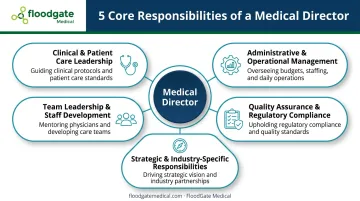
Clinical & Patient Care Leadership
Medical Directors set the tone for patient care quality across their organization. This includes:
- Overseeing treatment protocols and clinical guidelines
- Serving as a go-to clinical resource for physicians, nurses, and mid-level practitioners
- Reviewing complex or high-risk cases
- Monitoring patient outcomes and identifying gaps in care delivery
Administrative & Operational Management
Clinical judgment only gets you so far without operational skill. Medical Directors also handle:
- Budget oversight for their department or service line
- Staffing decisions, including hiring and scheduling
- Coordination with other department heads to keep operations running smoothly
- Resource allocation across competing clinical priorities
Quality Assurance & Regulatory Compliance
This is where the role carries real legal weight. Medical Directors typically manage:
- Quality improvement initiatives across departments
- Licensure and accreditation compliance
- Clinical risk exposure
In federally regulated settings like nursing facilities and hospice, this isn't optional. CMS conditions of participation explicitly require physician oversight of care policies and medical decision-making.
Team Leadership & Staff Development
Beyond managing operations, Medical Directors mentor the next generation of clinical talent. Responsibilities here include:
- Training and developing physicians and clinical staff
- Leading hiring decisions for clinical roles
- Resolving conflicts between departments or care teams
- Modeling the clinical standards they expect from others
Strategic & Industry-Specific Responsibilities
In MedTech and device companies, the role stretches further. These Medical Directors guide clinical strategy, provide product safety input, and contribute to regulatory submissions — translating physician judgment into evidence that satisfies both clinical and commercial stakeholders.
Finding physician-leaders who can operate this way is genuinely hard. It requires someone comfortable in a clinical setting and a boardroom. Specialized recruiters like FloodGate Medical focus specifically on placing MedTech professionals who bridge that gap, rather than treating a Medical Director search like any other executive hire.
Medical Director Qualifications and Requirements
Qualifications for this role follow a fairly predictable path, though the details shift by specialty and setting.
Education Requirements
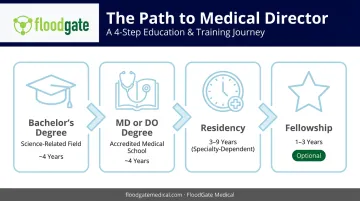
The standard route includes:
- A bachelor's degree, typically in a science-related field
- An MD or DO degree from an accredited medical school
- Completion of residency in a relevant specialty (generally 3-9 years, per the Bureau of Labor Statistics)
- A fellowship (1-3 years) for subspecialty roles, where applicable
Licensing & Board Certification
Every Medical Director needs a current, unrestricted state medical license. Depending on the role, employers also require:
- DEA registration, where prescribing authority applies
- Board certification in the relevant specialty
- Ongoing continuing medical education to maintain licensure
Board certification isn't legally mandatory everywhere, but most employers treat it as a baseline expectation for physician-executive roles.
Experience & Advanced Credentials
Most Medical Director postings expect several years of clinical practice before someone steps into a leadership seat. Beyond that baseline, certain credentials add real value depending on setting:
| Credential | Best Fit For |
|---|---|
| CMD (Certified Medical Director) | Post-acute and long-term care settings |
| CPE (Certified Physician Executive) | General physician leadership roles |
| FACHE (Fellow, American College of Healthcare Executives) | Healthcare management and operations |
| MBA or MHA | Roles with heavy strategic or financial responsibility |
None of these are universal requirements. List them as "preferred" unless your specific setting legally demands one — treating them as mandatory will shrink your candidate pool for no good reason.
Essential Skills for Medical Director Success
Clinical expertise gets a physician in the door. These skills determine whether they succeed once they're there.
- Leadership and interpersonal skills — managing diverse clinical teams, resolving conflict, and building trust across departments
- Regulatory knowledge — understanding compliance frameworks specific to the setting, from Joint Commission standards to CMS conditions of participation
- Analytical decision-making — reviewing outcomes data and adjusting protocols based on evidence, not instinct
- Business acumen — particularly critical for Medical Directors in MedTech or multi-site organizations, where budget and strategy decisions carry commercial consequences
The AAPL competency framework groups these into self-management, professional capability, teamwork, and communication: a useful lens for structuring interview questions if you're hiring for the role.
Medical Director Salary Expectations
Compensation for Medical Directors varies enormously by setting, so a single national number only tells part of the story.
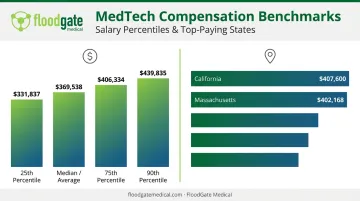
According to Salary.com, the average U.S. Medical Director base salary sits at $369,538, with a 25th-75th percentile range of $331,837 to $406,334 and a 90th percentile figure of $439,835.
Factors that move the number:
- Geographic location: California ($407,600 average) and Massachusetts ($402,168 average) rank among the highest-paying states
- Industry: hospital roles, MedTech clinical affairs positions, and long-term care directorships use very different pay structures
- Organization size: larger systems and multi-site companies typically pay more
- Years of experience: as with most executive roles, tenure and prior leadership experience command a premium
One caution worth flagging: long-term care and hospice Medical Director roles are often part-time or stipend-based rather than full-time salaried positions. Don't compare those figures directly against a full-time hospital or MedTech salary; you'll end up with a misleading benchmark. FloodGate Medical helps MedTech employers and candidates benchmark Medical Director compensation correctly across these different settings.
How to Write a Medical Director Job Description That Attracts Top Talent
A strong job posting does more than list duties. It sets clear expectations and signals to the right candidates that this role is worth their time.
Essential components of an effective posting:
- Clear, specific title: avoid vague or interchangeable titles like "Clinical Director" if the role legally requires a physician
- Organization summary: brief context on your setting, patient population, and mission
- Key responsibilities: tied to measurable outcomes (quality metrics, compliance targets, staff development goals), not generic duty lists
- Required vs. preferred qualifications: separate legal minimums (license, board certification) from nice-to-haves (CMD, MBA)
- Compensation and benefits: a dated salary range builds trust and reduces wasted interviews
Language matters too. Bias-free, inclusive wording widens your qualified candidate pool rather than narrowing it. Firms like FloodGate Medical build their recruitment approach around equity and inclusion, offering a useful model for MedTech companies looking to make their own postings more accessible to a broader range of qualified physician-leaders.
Even a well-written, inclusive posting won't fix everything. MedTech companies that struggle to fill a Medical Director seat usually face a deeper issue: limited access to physicians who understand both clinical practice and commercial strategy. That's a narrow pool, so partnering with a recruiter who specializes in MedTech, rather than healthcare generally, can shorten the search considerably.
Frequently Asked Questions
What is the role of the medical director?
A Medical Director oversees clinical operations, sets medical policy, and ensures quality patient care while acting as a bridge between administration and clinical staff. Specific duties shift depending on the organization's setting.
What is the difference between a clinical director and a medical director?
A Medical Director must be a licensed physician (MD or DO). A Clinical Director may oversee clinical operations without holding a medical degree, often coming from nursing or administrative backgrounds instead.
Is a medical director also a doctor?
Yes. A Medical Director is required to be a licensed MD or DO, and board certification in the relevant specialty is expected in most settings. This distinguishes the title from purely administrative director roles.
How much does a medical director make in the US?
Average base salary sits around $369,538, with most professionals earning between roughly $332,000 and $406,000 depending on percentile. Pay varies by industry, location, and experience level.
Who does a Medical Director report to?
Reporting lines depend on the organization. Hospital-based Medical Directors typically report to a medical executive committee and senior administration, while MedTech roles report to a CMO or VP of Medical Affairs.
What qualities make a good Medical Director?
Strong Medical Directors combine clinical credibility with leadership and regulatory judgment. The best ones move comfortably between bedside decisions and boardroom strategy, a blend FloodGate Medical looks for when placing MedTech leadership talent.

![Medical Practice Manager Job Description [Updated for 2026]](https://file-host.link/website/floodgatemedical-yc9tym/assets/blog-images/aaa27d1a-a01c-4fb8-b5f3-41b7461ce7f8/1785145357693488_9e5775b277a243ac90b133a686093465/1080.webp)