The problem? Most MA resumes fail before a human ever reads them. The role blends two distinct skill sets, clinical and administrative, and a generic resume signals neither convincingly. It reads vague. It gets skipped.
This guide breaks down exactly what to fix: ATS-ready structure, entry-level and experienced examples, section-by-section writing formulas, and specialty tailoring tips for family practice, pediatrics, urgent care, and dermatology roles.
Key Takeaways
- List certifications (CMA, RMA, CCMA) with issuer and expiration date under your name
- Write every bullet as [action verb] + [specific task] + [quantifiable result]
- Separate clinical and administrative skills, citing real EHR systems like Epic or Cerner
- Match resume length to experience: one page usually, two only for supervisory or multi-specialty roles
Medical Assistant Resume Structure: What ATS and Recruiters Look For
Recruiters don't read resumes line by line; a widely cited Ladders eye-tracking study found the average initial screen lasted just 7.4 seconds. That's barely enough time to register your name and job title, let alone hunt for buried credentials.
The Order That Gets Noticed
Put the highest-value information first:
- Contact header - name, phone, email, city/state
- Certifications bar - credential, issuer, expiration date
- Professional summary - 2-3 lines, specialty-specific
- Clinical skills
- Administrative skills (including named EHR systems)
- Experience with quantified bullets
- Education
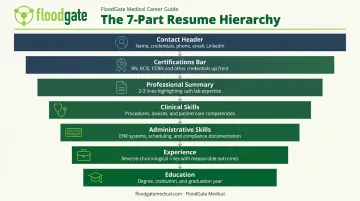
If your certification and EHR experience aren't visible in the first few lines, most recruiters won't dig for them.
Format Rules That Actually Matter
Skip the two-column templates and graphics. According to Jobscan's ATS formatting guidance, many applicant tracking systems parse resumes top-to-bottom and can scramble or drop content placed in tables, text boxes, or columns. A single-column, standard-font resume (Arial, Calibri, Times New Roman) parses cleanly across most platforms, including the ATS systems many hospital systems rely on.
Specificity beats generic phrasing every time; compare these two lines:
- Vague: "Experience with electronic medical records"
- Specific: "Epic EMR, 2 years, daily charting and scheduling"
The second version hits an actual keyword an ATS is scanning for. The first one might as well be blank.
Page length: No MA-specific study sets this rule, but as practical guidance: one page covers most candidates under five years of experience. Two pages make sense only when supervisory duties, multiple specialty settings, or extensive certifications genuinely require the space.
Medical Assistant Resume Examples by Experience Level
Entry-Level Medical Assistant Resume Example (No Experience)
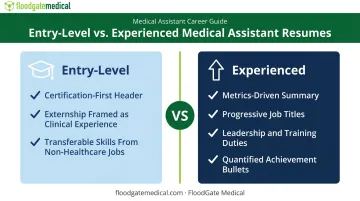
If you're fresh out of an MA program, lead with education and certification, then treat your externship as real clinical experience, not a footnote.
Sample structure:
- Contact header + certification (CCMA, pending or earned)
- Summary: "Recent CCMA graduate with 160-hour clinical externship at [facility], experienced in vitals, EKG, and patient intake."
- Education & certification (school, program, graduation date, credential)
- Clinical externship experience (facility name, hours completed, procedures performed)
- Transferable skills from prior non-healthcare jobs
- Skills section (clinical + administrative)
Sample bullets:
- Roomed and prepped an average of 12-15 patients per shift during a 160-hour externship at a family medicine clinic
- Documented vitals and chief complaints in Athenahealth with zero charting errors flagged during supervisor review
- Applied customer service skills from 2 years in retail to manage front-desk scheduling and patient check-in during clinical rotations
Don't underestimate retail, customer service, or childcare experience. A candidate who "handled 50+ customer interactions daily" already knows how to multitask under pressure, which is exactly what hiring managers want to see.
Experienced Medical Assistant Resume Example
For MAs with a few years under their belt, the summary should lead with metrics, not adjectives.
Sample structure:
- Contact header + active certification with expiration date
- Summary: "CMA with 5 years in urgent care, proficient in Epic EMR, reduced patient wait times by 20% through improved triage workflow."
- Progressive job titles showing growth
- Leadership or training responsibilities
- Quantified experience bullets
- Skills, education
Sample bullets:
- Managed daily patient volume of 35-40 in a high-traffic urgent care clinic, maintaining a 98% on-time charting rate
- Trained 4 incoming medical assistants on Epic EMR workflows, cutting onboarding time from 3 weeks to 10 days
- Reorganized the point-of-care testing supply station, cutting average result turnaround by 15 minutes
Specialty-Specific Resume Snapshots
Keyword emphasis shifts based on where you work. Swap in the exact EHR system and procedures that match your actual job posting:
| Setting | Emphasize |
|---|---|
| Family Practice | Vitals, blood draws, EKGs, suture removal, order entry |
| Pediatrics | Immunizations, growth screenings, patient/family communication |
| Urgent Care | Point-of-care testing, rapid triage, specimen collection |
| Dermatology | Biopsy assistance, sterilization protocols, prior authorizations |
Never list a duty you haven't actually performed. Recruiters in specialty settings ask pointed follow-up questions, and a mismatch will surface fast in an interview. If you want a second opinion before applying, career coaches who specialize in healthcare hiring—like the team at FloodGate Medical—can help you spot these gaps and tighten your resume language for the role you're targeting.
How to Write Every Section of Your Resume
Professional Summary or Objective
Use this formula: specialty/setting + years of experience + named EHR system + one quantified achievement.
- Entry-level: "CCMA-certified medical assistant with 160-hour pediatric externship, trained in Athenahealth documentation and immunization administration."
- Experienced: "CMA with 6 years in dermatology, proficient in Epic EMR, supported 200+ biopsy procedures annually with zero sterilization compliance issues."
Skip the objective statement ("Seeking a position where I can grow"). It says nothing an employer needs.
Certifications
Format each credential the same way: credential name, issuing body, expiration date. Place this directly under your header, not buried near education.
| Credential | Issuer | Renewal Cycle |
|---|---|---|
| CMA | AAMA | Every 60 months |
| RMA | AMT | Annual renewal + 30 CCP points per 3-year cycle |
| CCMA | NHA | Every 2 years, 10 CE credits |
The U.S. Bureau of Labor Statistics (BLS) notes that employers often prefer certified medical assistants, so an active, correctly dated credential is one of the strongest signals on your resume.
Skills Section: Clinical, Administrative, and EHR Systems
Split this into two columns instead of one long list:
Clinical skills:
- Vitals
- Phlebotomy
- EKG administration
- Wound care
- Injections
Administrative/EHR skills:
- Scheduling
- Insurance verification
- Epic EMR
- Athenahealth
- Medical coding
Only name systems you've actually used hands-on. Epic leads adoption in both hospital and ambulatory settings, Oracle Cerner is heavily used in hospitals, and athenahealth is common in ambulatory clinics. Naming the real system beats writing "EHR software" every time.
Experience Bullets
The formula: [action verb] + [specific task] + [quantifiable result].
- Before: "Assisted with patient care and documentation."
- After: "Roomed 18 patients daily and documented vitals in Cerner with a 99% charting accuracy rate."
The second version gives a recruiter something to picture, and something to compare against other candidates.
Common Medical Assistant Resume Mistakes to Avoid
These slip-ups show up constantly on Medical Assistant resumes — and they're often the reason a qualified candidate gets passed over.
- Sending one generic resume everywhere. A dermatology posting and an urgent care posting want different keywords. Tailor both.
- Burying certifications mid-page. If your CMA or RMA isn't visible in the first few lines, it might as well not be there.
- Skipping the issuing body and expiration date. "CMA" alone tells a recruiter nothing about whether you're currently active.
- Writing vague duties instead of results. "Assisted with patient care" says nothing, while "Roomed 15 patients per shift with zero documentation errors" says everything.
Tailoring Your Resume and Growing Beyond the Medical Assistant Role
Every job posting has repeated keywords, usually the named EHR system and 3-4 specific procedures. Pull those terms directly from the posting and mirror them naturally in your summary and skills section. If a posting mentions "point-of-care testing" three times, that phrase belongs on your resume, not a synonym for it.
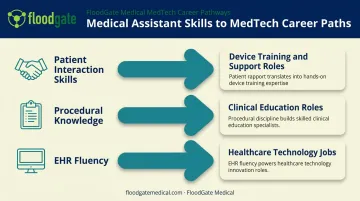
That precision matters beyond daily tailoring, too. Many experienced MAs eventually use their clinical-plus-administrative foundation as a launchpad into broader healthcare and MedTech roles, think clinical education, device support, or patient services roles at medical device companies.
That overlap runs deeper than it looks:
- Patient interaction skills transfer to device training and support roles
- Procedural knowledge translates to clinical education roles
- EHR fluency applies across most healthcare technology jobs
This is where a specialized recruiter can help. FloodGate Medical focuses exclusively on connecting healthcare and MedTech talent with employers, using a diversity-driven recruitment approach built to widen the pool of candidates considered for a role rather than narrow it. For MAs exploring what comes next, FloodGate Medical also publishes a monthly newsletter with industry insights and open opportunities worth following.
Whether you stay in direct patient care or explore a MedTech path, ongoing certification and continuing education keep your resume competitive as demand for MedTech talent keeps rising.
Frequently Asked Questions
What to put on a medical assistant resume?
Lead with named certifications and expiration dates, a named EHR system, and clearly separated clinical and administrative skills. Back each experience bullet with quantified results, and skip generic phrasing entirely.
What is a good headline for a medical assistant resume?
An effective summary names your specialty, years of experience, certification, and one measurable achievement instead of a generic objective statement like "seeking a position."
How to write a resume for medical assistant with no experience?
Lead with your education and certification, and treat your externship as real clinical experience, naming the facility and hours completed. Then reframe non-healthcare jobs like retail or customer service as transferable skills.
What certifications should be on a medical assistant resume?
List CMA, RMA, or CCMA as your primary credential, plus BLS/CPR certification. Add specialty certifications only if they're relevant to your target role.
What EHR systems should I list on my medical assistant resume?
List only systems you've used hands-on, such as Epic, Cerner, or Athenahealth. Name the specific system rather than writing "electronic medical records" generically.
How long should a medical assistant resume be?
One page works for most candidates with under five years of experience. Two pages are justified only when supervisory duties or multiple specialty settings add genuine depth.