
Introduction
Few careers blend hard science with hands-on patient care quite like medical physics. It's a field where you're calculating radiation doses one hour and consulting with an oncologist the next, all while equipment worth millions of dollars hums in the background.
Demand for this expertise isn't slowing down. According to the Bureau of Labor Statistics' Occupational Outlook Handbook, physicist and astronomer roles will grow 4% from 2024 to 2034, adding roughly 1,800 openings a year across the broader occupation category.
Within medical physics specifically, rising cancer rates and an aging workforce are pushing hospitals to compete hard for qualified talent — which can make breaking into the field feel daunting for newcomers.
This guide breaks down what medical physicists actually do, the specializations available, how to get certified, what you can expect to earn, and how to land your first role.
Key Takeaways
- Medical physicists apply physics to diagnose and treat disease through radiation therapy, imaging, and nuclear medicine
- The standard path includes a bachelor's degree, CAMPEP-accredited graduate training, a two-year residency, and board certification
- Job prospects remain strong, with certified professionals often earning over $200,000
- Opportunities extend into MedTech and device companies, where firms like FloodGate Medical link physics talent to employers through staffing and career coaching
What Does a Medical or Clinical Physicist Do?
Medical physics is the application of physics principles to diagnose, treat, and manage disease. Practitioners work side by side with radiologists, radiation oncologists, and technologists rather than in isolation at a lab bench.
The American Association of Physicists in Medicine (AAPM) organizes the profession around three pillars, as outlined in its official medical physicist career overview: clinical service and consultation, research and development, and teaching. Most working physicists spend the bulk of their time on the clinical side, with research and teaching layered in depending on the setting.
Scope of Daily Responsibilities
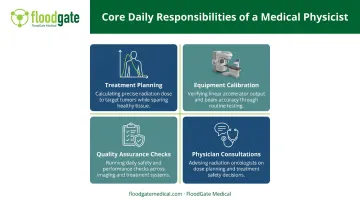
A typical day might include:
- Treatment planning for radiation oncology patients, calculating precise dose distributions
- Equipment calibration on linear accelerators, CT scanners, or PET/SPECT systems
- Quality assurance checks to confirm machines are performing within safety tolerances
- Physician consultations on complex cases requiring custom dosing or imaging protocols
Patient safety sits at the center of all of it. Medical physicists optimize radiation doses so patients get enough to treat disease without unnecessary exposure, and they build the safety protocols that keep staff and the public protected too.
Work Environment
You'll find medical physicists in:
- Hospitals and academic medical centers
- Private radiation oncology or imaging practices
- Research institutes and universities
- MedTech and device manufacturing companies
Most work a standard 40-hour week during daytime hours. That said, evening or weekend work does happen, particularly for urgent treatment planning or when new equipment needs commissioning outside of clinical hours.
Career Specializations in Medical Physics
Nearly every medical physicist settles into a subfield rather than practicing broadly across all of them. According to AAPM's 2019 professional workforce survey of over 2,500 respondents, 76% reported radiation oncology as their primary subspecialty. Diagnostic and nuclear medicine physics make up smaller, sometimes overlapping segments of the field.
Therapeutic (Radiation Oncology) Medical Physics
This is the largest specialty by far. Therapeutic physicists focus on cancer treatment: planning radiation doses, running calculations for individual patients, and performing daily quality assurance on linear accelerators. Many also specialize further in techniques like IMRT, stereotactic radiosurgery, or brachytherapy as treatment technology grows more complex. They work in near-constant partnership with radiation oncologists to ensure treatments hit their targets accurately.
Diagnostic Medical Physics
Diagnostic physicists optimize image quality across CT, MRI, mammography, and ultrasound systems while keeping patient radiation exposure as low as reasonably achievable. The same 2019 survey estimated that 1,794 physicists supported diagnostic imaging, with 1,073 holding board certification in the specialty.
Nuclear Medicine Physics
This specialty centers on radioactive tracers and theranostics, supporting PET and SPECT imaging along with radiopharmaceutical treatments. The same survey found roughly 934 physicists working in nuclear medicine, though only 235 practiced exclusively in that niche.
Health Physics (Radiation Safety)
Health physicists protect patients, staff, and the public from radiation hazards. Their work leans heavily on regulatory compliance, shielding design, and facility-level safety audits rather than direct patient treatment planning.
Beyond these four clinical tracks, a growing number of physicists move into research, academia, or industry roles at MedTech and device companies. Device manufacturers increasingly need physics expertise for product development, testing, and regulatory submissions—an emerging path we'll explore later.
Education, Training & Certification Path
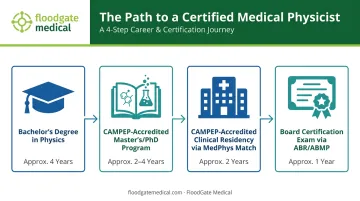
Becoming a medical physicist requires a defined sequence of steps. There's no shortcut here, but the path is well-mapped:
- Earn a bachelor's degree in physics or a closely related natural science, building the foundation you'll need for graduate coursework.
- Complete a CAMPEP-accredited master's or PhD program in medical physics. A master's typically runs two academic years and prepares you for clinical practice; a PhD adds research depth and opens doors to academic or industry roles.
- Complete a CAMPEP-accredited clinical residency, secured through the MedPhys Match process. Standard tracks run at least two years full-time; combined imaging and nuclear medicine tracks take three. Matches are binding absent written mutual release.
- Pass board certification exams through the American Board of Radiology (ABR) or American Board of Medical Physics (ABMP). ABR certifies across therapeutic, diagnostic, and nuclear medical physics; ABMP adds medical health physics and MRI physics as certification tracks.
State licensure adds another layer, and it varies more than most people expect:
| State | Regulatory Approach |
|---|---|
| New York | Individual license across four specialties |
| Florida | Individual license under the Medical Physicists Act |
| Texas | Individual license through the Texas Medical Board |
| Hawaii | Facility/service licensing with QMP requirements, no standalone personal license |
Most other states rely on Qualified Medical Physicist (QMP) registration rather than a dedicated state license. Once certified, continuing education keeps you current as imaging and treatment technology evolves, and most certifying boards require it for maintenance of certification.
Skills, Salary & Career Outlook
Key Skills for Success
The best medical physicists combine technical rigor with people skills. Core strengths include:
- Strong analytical and critical thinking abilities for troubleshooting equipment issues
- Attention to detail, since dosing errors carry real patient risk
- Solid math and science aptitude, particularly in applied physics and statistics
- Interpersonal skills for working closely with oncologists, radiologists, and technologists
Salary and Job Outlook
Compensation climbs sharply with certification and degree level. According to AAPM's 2023 Professional Survey Report:
| Group | Mean Income | Median Income |
|---|---|---|
| Master's, no certification | $168,800 | $168,700 |
| Master's, certified | $231,400 | $230,000 |
| PhD, no certification | $180,900 | $180,000 |
| PhD, certified | $241,200 | $233,000 |
Residents, still in training, averaged $62,900 annually. The jump after certification is substantial, and it's one reason the credentialing process, tedious as it is, pays off.
Beyond compensation, demand is climbing for two reasons: an aging population needing more cancer treatment and diagnostic imaging, and a wave of retirements thinning the current workforce. PhD holders, in particular, have room to move into research leadership, department management, or tenure-track academic positions as their careers progress. Career coaching for medical professionals can help those weighing the certification investment or eyeing a move into leadership roles.
Getting Started: Launching Your Medical Physics Career
If you're still early in the process, a few moves make a real difference:
- Shadow a practicing medical physicist at a local hospital to see the day-to-day reality before committing years of graduate study
- Join AAPM's student resources, which include mentorship programs and career guidance built specifically for people entering the field
- Pursue a CAMPEP-accredited undergraduate research fellowship to get lab and clinical exposure ahead of graduate applications
Hospitals aren't the only destination anymore. MedTech and device manufacturers increasingly recruit physics talent for R&D, regulatory support, and clinical application roles, and qualified candidates are often in short supply.
This is where a specialized recruiter earns its keep. FloodGate Medical works exclusively within the MedTech industry, placing more than 450 professionals annually across commercial, clinical, and leadership functions, with an 89% one-year retention rate.
The firm's DEI-driven approach to hiring builds stronger, more diverse teams for the healthcare technology employers it partners with.
For physicists weighing a move from a clinical setting into industry, resources like FloodGate Futures career coaching and the Breaking Into MedTech guide offer a starting point. They provide guidance for that transition rather than guesswork.

Frequently Asked Questions
What is the highest salary for a medical physicist?
Top earners are typically PhD-holders with board certification working in senior clinical or academic roles, and top industry leadership positions. Among certified PhD radiation oncology physicists, the 80th percentile of total income reaches $393,600, per AAPM's 2023 salary survey.
Is medical physics a promising career?
Yes. Steady demand comes from an aging population needing more cancer treatment and imaging, alongside a wave of upcoming retirements in the field. Broader physicist occupations are projected to grow 4% through 2034, per BLS.
What can I do with a medical physics degree?
You can work clinically in hospitals, pursue academic or research positions at universities, or move into industry roles at MedTech and device companies handling R&D, regulatory affairs, quality assurance, or clinical support.
How long does it take to become a medical physicist?
Expect roughly four years for a bachelor's degree, two to six years for a master's or PhD, and two more years for a CAMPEP-accredited residency before sitting board certification exams.
Do you need a PhD to become a medical physicist?
No. A master's degree is sufficient for most clinical roles. A PhD is generally reserved for those pursuing academic and research-focused paths, or roles on the leadership track.
What's the difference between a medical physicist and a health physicist?
Medical physicists focus on patient diagnosis and treatment, primarily in radiation therapy and imaging. Health physicists focus on radiation safety and regulatory compliance, protecting both staff and the public.