
Here's what a lot of pre-med and science undergrads don't realize: you don't need to go to medical school to build a physician-level career in anesthesia care. The Certified Anesthesiologist Assistant (CAA) path offers exactly that, minus a decade of training.
This guide walks through the education requirements, certification process, salary expectations, and how the CAA role stacks up against becoming a CRNA or anesthesiologist. We'll also cover where AAs can legally practice and how the career can evolve over time.
Key Takeaways
- Becoming a CAA typically requires a bachelor's degree plus a 24-28 month master's program
- Certification eligibility requires roughly 2,000 clinical hours and 650 cases
- Practice authorization currently spans 24 U.S. jurisdictions, plus all VA facilities nationwide
- Starting salaries hover around $150,000, with strong long-term earning potential
- Physician supervision remains mandatory for CAAs, unlike CRNAs, whose autonomy varies by state
What Is an Anesthesiologist Assistant?
A Certified Anesthesiologist Assistant is a master's-level anesthesia provider who works under the direct supervision of a licensed anesthesiologist to carry out anesthesia care plans. CAAs don't operate independently. They function as part of an anesthesia care team, with the supervising physician retaining ultimate responsibility for the patient.
This team-based model isn't new. Anesthesiologists created the role in the early 1960s to address anesthesia staffing shortages and growing case complexity, the same pressures the field faces again today. The first training programs launched at Emory University and Case Western Reserve University in 1969, and both schools still run respected CAA programs.
Core responsibilities include:
- Conducting pre-anesthesia patient assessments
- Establishing IV access and arterial lines
- Administering and monitoring anesthesia during procedures
- Managing airways, including intubation
- Providing postoperative care and monitoring recovery
The CAA functions as the physician anesthesiologist's clinical right hand: highly trained, hands-on, but never working solo.
Step-by-Step Path to Becoming an Anesthesiologist Assistant
Getting to the CAA credential takes roughly six to seven years total. Here's how it breaks down.
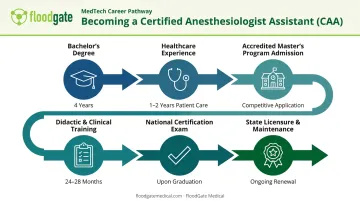
Step 1: Complete a Bachelor's Degree
Admissions committees want a premedical science background. That means biology, general and organic chemistry, physics, and advanced math, usually with labs attached. Programs like Emory's prefer a B or better in every prerequisite course.
A strong GPA isn't optional here. CAA master's programs are competitive, and a shaky transcript in organic chemistry or physics will hurt your application more than almost anything else.
Step 2: Gain Relevant Healthcare Experience
Classroom knowledge alone won't get you in. Admissions committees consistently favor applicants with hands-on clinical exposure. Consider:
- Shadowing anesthesiologists or CAAs in a hospital or surgical center
- Working as an EMT, CNA, or medical scribe
- Participating in clinical research
This experience does two things: it strengthens your application, and it confirms you actually want to spend your career in an OR.
Step 3: Get Into an Accredited AA Master's Program
CAA programs are accredited through CAAHEP and must be affiliated with an LCME-accredited medical school (or an AOA-accredited osteopathic school). That affiliation matters, since it's what gives these programs their medical-school-caliber clinical training.
There aren't many programs nationwide, and estimates on the exact count vary between sources, so check CAAHEP's live directory for the current list before applying. Most programs require either the MCAT or GRE, with Emory requiring scores no older than five years.
Step 4: Complete Didactic and Clinical Training
Programs run 24 to 28 months and split time between classroom instruction and clinical rotations. Coursework covers physiology, pharmacology, anatomy, and anesthesia-specific subjects.
The clinical requirement is substantial. Current NCCAA certification guidelines call for a minimum of 2,000 clinical hours and 650 administered anesthesia cases before you're eligible to sit for the certifying exam. Case Western's curriculum, for example, includes rotations in cardiothoracic, neurosurgical, obstetric, and pediatric anesthesia, along with nerve block training.
Step 5: Pass the National Certification Exam
Once you've completed your program, you'll sit for the Certifying Examination for Anesthesiologist Assistants, developed and administered by the NCCAA (with Pearson VUE handling test-center delivery).
Pass it, and you earn the right to use the CAA designation after your name. Candidates get up to six attempts within a two-year eligibility window, so there's some room for a rough exam day.
Step 6: Obtain State Licensure and Maintain Certification
Certification alone doesn't let you practice. You'll also need licensure in whichever state you plan to work. From there, maintaining your CAA status requires 50 CME hours every two years, plus a continued certification check-in starting in year four, then years 10, 20, and 30.
Skip these requirements, and your credential lapses. Maintaining CAA status takes continuous effort throughout your career.
CAA vs. CRNA vs. Anesthesiologist: Which Path Is Right for You?
If you're weighing a career in anesthesia care, this comparison probably matters more than any other decision you'll make. Each path trades training time against autonomy and pay in a different way.
| Path | Education Required | Compensation Benchmark | Practice Authority |
|---|---|---|---|
| CAA | Bachelor's + 24-28 month master's | ~$150,000 starting salary | Always requires physician-anesthesiologist supervision |
| CRNA | Nursing degree + graduate nurse-anesthesia program (often 36 months) | $223,210 median (May 2024) | Autonomy varies; 25 states had opted out of Medicare's supervision requirement as of May 2024 |
| Anesthesiologist | 4-year degree + 4 years med school + 4-year residency | $339,470 mean (May 2023) | Full independent practice authority; leads the care team |
Source: BLS Occupational Outlook Handbook
A few things stand out here:
- Training length favors CAAs and CRNAs over the physician path by nearly a decade
- Educational background is the real fork in the road. CAAs come from a science degree, CRNAs from nursing
- Autonomy is where these paths diverge most: CAAs never practice independently, CRNA independence hinges on state law, and anesthesiologists retain full authority everywhere
If autonomy matters most to you, the physician route is the only one that guarantees it. If you want a shorter runway to a strong salary without a nursing background, CAA is worth serious consideration.
Salary, Job Outlook, and Where Anesthesiologist Assistants Work
CAA starting salaries land around $150,000, based on data from the American Academy of Anesthesiologist Assistants. That's a strong entry point for a career that requires roughly two years less training than nursing-to-CRNA or medical school routes.
Where Can You Legally Practice?
This is the part every prospective CAA needs to check carefully. AAs are currently authorized to practice in 24 jurisdictions, covering 22 states plus Washington, D.C. and Guam, according to the American Academy of Anesthesiologist Assistants.
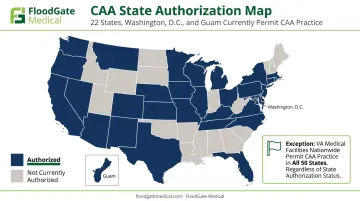
One notable exception: CAAs can work at VA facilities in all 50 states, regardless of state-level scope-of-practice laws.
Scope-of-practice rules shift as state legislatures act on them, so verify current regulations before choosing a program or accepting a job offer in a specific state.
Common Work Settings
CAAs typically practice in:
- Hospitals and academic medical centers
- Ambulatory surgery centers
- VA facilities
- Larger institutions handling cardiac, neurosurgical, transplant, and trauma cases
Job Outlook
There's no CAA-specific federal projection since the BLS folds nurse anesthetists, midwives, and nurse practitioners into one combined category. That said, the underlying driver — rising surgical volume paired with anesthesia staffing shortages — points toward continued demand for anesthesia care team members, CAAs included.
Pros, Cons, and Career Growth Opportunities
Like any healthcare career, the CAA path comes with real trade-offs worth weighing before you commit years of training.
The upsides:
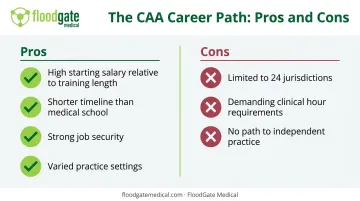
- High starting salary relative to training length
- Shorter timeline than medical school (roughly 6-7 years vs. 12+)
- Strong job security tied to persistent anesthesia workforce shortages
- Variety across hospital, ambulatory, and academic settings
The downsides:
- Limited to 24 jurisdictions, which restricts where you can live and work
- Demanding clinical hour requirements during training (2,000+ hours, 650+ cases)
- No path to independent practice, unlike CRNAs in opt-out states or physicians
Experienced CAAs aren't locked into one lane forever, either. Many pursue additional exposure in pediatric, cardiothoracic, or neuroanesthesia settings.
Others eventually pivot into MedTech-adjacent roles such as clinical education, device training, or clinical specialist positions. Their procedural background in the OR becomes a genuine asset for medical device companies building out commercial and clinical teams.
That's where specialized recruiters come in. Firms like FloodGate Medical focus exclusively on MedTech placement, offering permanent recruiting, contract staffing, and career coaching for clinicians. Their teams help CAAs translate hands-on anesthesia experience into new career paths as their goals shift over time.
Frequently Asked Questions
How many years does it take to become an anesthesiologist assistant?
Plan on roughly 6-7 years total: a 4-year bachelor's degree followed by a 24-28 month master's program. Exact timing depends on prerequisite coursework and program pacing.
What is the highest salary for anesthesiologist assistants?
Pay climbs steadily with experience, specialization, and practice location, though no public source publishes a definitive top-earner figure. National starting salaries average around $150,000, with experienced CAAs in high-demand markets earning well above that baseline.
Can anesthesiologist assistants draw blood?
Yes. Obtaining IV access, drawing arterial and venous blood samples, and using delegated invasive monitoring techniques all fall within a CAA's scope of practice under physician supervision.
Is becoming an anesthesiologist assistant a good career choice?
It offers strong pay and job security with a shorter training path than medical school. The trade-offs are limited practice-state availability and demanding clinical training hours.
Can anesthesiologist assistants work in every U.S. state?
No. CAAs are currently authorized in 24 jurisdictions (22 states, D.C., and Guam), plus VA facilities nationwide. Always verify current state regulations before choosing a program or job location.
What's the main difference between a CAA and a CRNA?
CAAs always require physician supervision, while CRNA autonomy varies by state. CAAs come from a science degree background; CRNAs come from nursing.