That's good news if you're considering the field. Sonography offers a rare combination in healthcare: a relatively short training timeline (as little as two years for an associate's degree), strong earning potential, and the chance to directly impact patient outcomes every single day.
This guide walks through what the job actually involves, how to get certified, what different specialties pay, and a career path many aspiring sonographers never consider: moving into the broader MedTech industry.
Key Takeaways
- An associate's degree is the most common entry point, though certificate and bachelor's paths also qualify
- Median pay sits at $89,340 annually, with outpatient care centers paying the most
- BLS projects 13% job growth through 2034, far outpacing many allied health roles
- CAAHEP-accredited programs and ARDMS certification are essential for employability
- Clinical sonography experience directly translates into MedTech sales, training, and product roles
What Is a Diagnostic Medical Sonographer?
A diagnostic medical sonographer uses a handheld device called a transducer to send high-frequency sound waves into the body. Those waves bounce back and form real-time images that physicians use to diagnose everything from gallstones to heart valve defects.
You'll often see the job posted under a different name. "Sonographer" and "ultrasound technician" get used interchangeably in most job listings, though "sonographer" typically signals a higher level of formal education and specialty certification.
A Typical Day on the Job
No two shifts look identical, but most sonographers move through a similar rhythm:
- Prep the patient: explain the procedure, answer questions, and position them correctly
- Capture images: adjust equipment settings for the specific exam, whether abdominal, cardiac, or vascular
- Maintain equipment: clean and calibrate machines between patients following infection-control protocols
- Coordinate with physicians: document findings and flag anything urgent for radiologist review
The job blends hands-on technical skill with genuine patient interaction, often during patients' most anxious moments before a diagnosis.
How to Become a Diagnostic Medical Sonographer: Education, Certification & Timeline
Choosing Your Education Path
Three main routes lead into sonography, and each fits a different starting point.
| Pathway | Typical Length | Best For |
|---|---|---|
| Certificate | Varies by program | Career-changers with prior healthcare experience |
| Associate's degree | 2 years | Most common entry point into the field |
| Bachelor's degree | 4 years | Those seeking broader clinical opportunities or advancement |
The associate's degree remains the benchmark most employers expect. That said, a certificate alone doesn't automatically qualify you for certification. Most certificate-route candidates need graduation from a related allied-health program plus roughly 12 months of full-time clinical ultrasound experience to meet ARDMS eligibility rules.
Why Accreditation Matters
Not all sonography programs carry equal weight. Look specifically for programs accredited by CAAHEP (the Commission on Accreditation of Allied Health Education Programs), based on a recommendation from the Joint Review Committee on Education in Diagnostic Medical Sonography (JRC-DMS).
Here's a key distinction: a program holding a "Letter of Review" is progressing toward accreditation, but it isn't accredited yet. That difference matters when you're applying for certification exams later, so confirm current status directly through CAAHEP's program search before enrolling.
Accredited programs build in supervised clinical training, where you'll scan real patients under a credentialed sonographer's supervision. This clinical component is often what separates job-ready graduates from those who struggle in their first role.
Certification and Licensure Steps
Once you've completed your education, certification through the American Registry for Diagnostic Medical Sonography (ARDMS) is next:
- Pass the SPI exam: Sonography Principles and Instrumentation, a foundational test covering physics and equipment knowledge
- Pass a specialty exam: chosen based on your intended focus area, completed within 5 years of passing SPI
- Check state licensure requirements: a handful of states, including New Hampshire, New Mexico, North Dakota, and Oregon, require separate licensure
Since requirements shift by state, verify current rules through CareerOneStop's occupation profile before assuming your certification transfers automatically.
Realistic Timeline
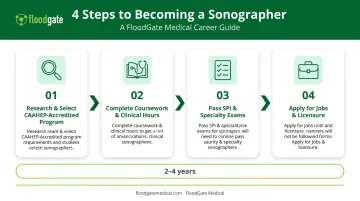
Here's the honest answer to "how long does this take?" Most people complete the journey in 2 to 4 years, depending on their chosen pathway:
- Research and select a CAAHEP-accredited program
- Enroll and complete didactic coursework plus supervised clinical hours
- Sit for the SPI exam, then your specialty certification exam
- Apply for jobs and, if required, secure state licensure
Two years covers the associate's degree route under ideal conditions. Add prerequisite coursework, competitive clinical placements, or exam retakes, and four years becomes a more realistic ceiling for many students.
Key Skills Every Sonographer Needs
Technical competence gets you in the door, but sonography demands a specific blend of hard and soft skills.
Technical skills you'll need to master:
- Operating and adjusting ultrasound equipment for different exam types
- Applying anatomy and physiology knowledge to recognize normal versus abnormal structures
- Optimizing images to produce diagnostically useful scans
- Following infection control and equipment sanitation protocols
Interpersonal skills matter just as much:
- Communicating clearly with anxious or uncomfortable patients
- Showing genuine compassion during sensitive exams, particularly obstetric or oncology-related scans
- Thinking critically and quickly when an image reveals something unexpected
One thing prospective students often overlook: this is a physically demanding job. You'll stand for long stretches, position patients who need physical assistance, and repeat precise hand movements for hours.
Shadow a working sonographer before committing to a program. Seeing the physical demands firsthand helps you decide if the role fits your stamina and pace.
Specializations & Career Paths in Sonography
Sonography splits into several specialty tracks, each with its own certification exam and clinical focus.
| Specialty Area | ARDMS Credential | Focus |
|---|---|---|
| Abdominal | RDMS | Organs, digestive system |
| OB/GYN | RDMS | Pregnancy, reproductive health |
| Cardiac (Echocardiography) | RDCS | Heart structure and function |
| Vascular | RVT | Blood vessels, circulation |
| Musculoskeletal (MSK) | RMSKS | Muscles, tendons, joints |
| Breast | RDMS | Breast tissue screening |
| Pediatric | RDMS | Children's imaging needs |
Many working sonographers don't stop at one credential. Cross-training into a second or third specialty pays off in concrete ways:
- Increases job versatility across exam types
- Boosts marketability to employers, especially smaller facilities
- Allows one sonographer to cover multiple modalities where staffing is tight
Keep in mind that certification isn't permanent. ARDMS requires 30 continuing education credits every three years to maintain active status across your credentials.
Musculoskeletal and vascular ultrasound have both seen expanded clinical use in orthopedics, sports medicine, and outpatient settings in recent years, making them worth watching as you plan your specialty path. Your specialty choice, as the next section shows, has a direct effect on where you can work and what you can earn.
Salary & Job Outlook: Which Sonography Specialties Pay the Most?
Let's get to the numbers most readers actually want.
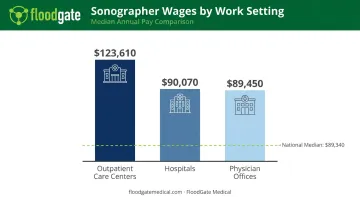
As of May 2024, diagnostic medical sonographers earned a median annual wage of $89,340, according to the Bureau of Labor Statistics. The bottom 10% earned under $64,760, while top earners cleared $123,170.
Pay by Work Setting
Where you work changes your paycheck more than most people expect:
| Setting | Median Annual Wage |
|---|---|
| Outpatient care centers | $123,610 |
| Hospitals (state, local, private) | $90,070 |
| Physician offices | $89,450 |
Outpatient care centers pay noticeably more than hospitals or physician practices. BLS doesn't break out wages by specialty nationally. However, cardiac and vascular sonographers often work in these higher-paying outpatient settings, giving them a real edge in pay.
Job Growth Outlook
The field is projected to grow 13% from 2024 to 2034, adding roughly 11,700 jobs and generating about 5,800 openings annually, per BLS projections. That growth stems from an aging population needing more diagnostic imaging and ultrasound's expanding use across specialties that once relied on other imaging modalities.
For context, cardiovascular technologists are projected to grow just 3%, and radiologic/MRI technologists sit around 5%. Sonography's growth rate outpaces both.
Pay and demand vary significantly by state and metro area. Before committing to a location, check your state's specific wage and demand figures through the BLS Occupational Employment and Wage Statistics database.
Beyond the Bedside: Expanding Your Sonography Career into MedTech
Clinical scanning isn't the only destination for a sonography career. A growing number of experienced sonographers transition into the medical technology industry, taking roles like Clinical Product Specialist, applications support, or sales-adjacent positions with ultrasound equipment manufacturers.
Here's why this path makes sense. MedTech companies building and selling imaging equipment need people who understand how the technology performs in real clinical settings, not just how it works on paper.
Someone who's spent years scanning patients can train hospital staff, troubleshoot equipment in the field, and speak credibly with clinicians in ways a purely commercial hire can't.
This is where FloodGate Medical comes in. As a recruitment firm focused exclusively on the MedTech industry, the firm helps clinically trained professionals, including sonographers, discover roles they may not have known existed outside the hospital or clinic.
Through its FloodGate Futures division, the firm offers resources specifically built for this kind of transition:
- A Career Transition Guide for professionals moving from clinical practice into industry roles
- A Breaking Into MedTech resource for candidates without prior commercial experience
- One-on-one Career Navigator consultations combining recruiting expertise with coaching
FloodGate Medical's approach is also grounded in a DEI-driven methodology, aimed at connecting diverse clinical talent with MedTech employers looking to build stronger, more representative teams.
If you're a sonographer curious about where your clinical background could take you, FloodGate Medical's candidate resources are worth exploring.

Frequently Asked Questions
Which field of sonography pays the most?
BLS doesn't publish national wage data by specialty. However, cardiac and vascular sonographers often earn more, partly because they frequently work in outpatient care centers—the highest-paying setting at $123,610 median annually.
How long does it take to become a sonographer in the US?
Most people complete training in 2 to 4 years, depending on whether they pursue a certificate, associate's degree, or bachelor's degree, plus time for certification exams.
Will sonography be replaced by AI?
AI is expected to help with image analysis and workflow efficiency, but it's unlikely to replace the hands-on scanning, patient interaction, and clinical judgment sonographers provide.
What is the difference between an ultrasound technician and a sonographer?
The terms are largely interchangeable in job postings today, though "sonographer" often implies more formal education and specialty certification through ARDMS.
Do you need a license to work as a diagnostic medical sonographer?
Requirements vary by state. A few states, such as New Hampshire and Oregon, require licensure, so check CareerOneStop or your state's licensing board for details.
Can you become a sonographer without a college degree?
Postsecondary certificate programs exist for those with prior healthcare experience, but an accredited associate's or bachelor's degree remains the most common and widely accepted path into the field.