Many hiring managers struggle to write a precise medical administrator job description. Candidates, meanwhile, often can't tell the difference between a "medical administrator," a "medical office administrator," and a "healthcare administrator." The titles overlap, and job boards don't help much.
This article breaks down what medical administrators actually do, the skills employers should screen for, current salary data, and a ready-to-use job description template you can adapt today.
Key Takeaways
- Medical administrators run nonclinical operations, including scheduling, records, billing, and staff coordination
- The role sits between entry-level office support and senior healthcare management
- Success requires both technical skills (EHR systems, billing, compliance) and people skills
- Demand is climbing across hospitals, clinics, and MedTech companies alike
- A well-structured job description is the single biggest lever for attracting qualified candidates
What Is a Medical Administrator?
A medical administrator is a nonclinical professional who manages the operational and administrative side of a healthcare or MedTech facility. They don't treat patients. They make sure the people who do have the schedules, records, staffing, and budgets they need to do their jobs.
Where the confusion sets in is title overlap. Here's a quick breakdown:
| Title | Scope | Typical seniority |
|---|---|---|
| Medical office administrator | Front-desk and clerical operations: scheduling, records, insurance basics | Entry-level |
| Medical administrator | Department- or facility-wide operations, budgets, staff supervision | Mid-level |
| Healthcare administrator | Strategic, organization-wide leadership; often executive-track | Senior/executive |
A medical office administrator handles the day-to-day front desk. A healthcare administrator sets strategy for an entire system. The medical administrator sits in between, running the operational engine of a department, clinic, or facility.
Where Do Medical Administrators Work?
Settings shift the day-to-day slightly, but the core function stays the same:
- Hospitals: larger teams, more regulatory oversight, department-specific budgets
- Private practices and clinics: leaner staff, broader personal responsibility
- **MedTech and healthcare device companies**: supporting clinical operations, compliance, and vendor relationships
- Long-term care facilities: heavier focus on staffing and regulatory documentation
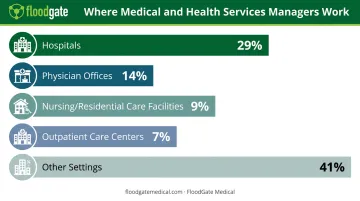
According to the Bureau of Labor Statistics, hospitals employed the largest share of medical and health services managers in 2024, at 29%. Physician offices followed at 14%, nursing and residential care facilities at 9%, and outpatient care centers at 7%. Hospitals remain the single biggest employer of this occupational category, though the BLS tracks this as a broader management group rather than a standalone "Medical Administrator" title.
Medical Administrator Responsibilities & Duties
Responsibilities vary by employer size and specialty, but they consistently fall into four buckets.
Administrative & Scheduling Duties
- Overseeing patient records management and appointment scheduling
- Coordinating referrals and specialist visits
- Managing front-office operations, correspondence, and supplies
- Keeping day-to-day workflow moving without bottlenecks
Financial & Billing Duties
- Managing billing and insurance claims processing
- Assisting with budgeting and financial planning for the department or facility
- Setting service rates where applicable
- Monitoring revenue cycle performance to catch gaps early
Compliance & Quality Improvement Duties
Ensuring HIPAA and other regulatory compliance is a core administrative function. HHS's Office for Civil Rights recorded 663 large healthcare data breaches that occurred or were resolved in 2024, affecting roughly 243 million people, and 81% involved hacking or IT incidents.
This data makes privacy and security workflow oversight a hands-on administrative responsibility rather than routine paperwork.
Medical administrators also lead quality improvement work:
- Analyzing patient care and operational data to spot inefficiencies
- Building corrective action plans when compliance reviews flag issues
- Coordinating with compliance officers on documentation standards
Staff & Team Management Duties
- Recruiting, hiring, and training administrative and support staff
- Supervising day-to-day performance and scheduling
- Collaborating with physicians, nurses, and department heads on policies that improve efficiency and patient safety
Skills & Qualifications Required
Strong candidates blend technical know-how with interpersonal skill. Neither alone is enough.
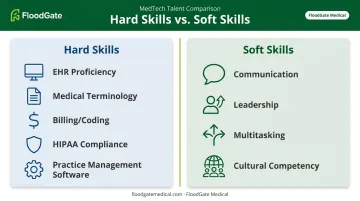
Hard Skills
- EHR and health information systems proficiency
- Working knowledge of medical terminology
- Billing and coding fundamentals, including insurance claims processing
- Regulatory compliance knowledge, particularly HIPAA
- Comfort with office and practice management software
Soft Skills
- Communication clear enough to bridge clinical staff, patients, and vendors
- Leadership that keeps a support team accountable without micromanaging
- Multitasking and problem-solving under pressure
- Cultural competency and empathy — this role interacts with a genuinely diverse mix of patients and staff daily
Education & Certification Requirements
Entry-level positions typically ask for a certificate or associate degree. Mid-level medical administrator roles increasingly prefer a bachelor's degree in healthcare administration or a related field.
Certifications strengthen a candidate's resume. The Certified Medical Administrative Assistant (CMAA) credential from the National Healthcareer Association is a common benchmark.
Per the NHA candidate handbook, the certification is valid for two years and requires 10 continuing education credits to renew. Candidates who let it lapse for over a year must retake the exam entirely, so treat certification status as something to verify, not assume.
Sample Medical Administrator Job Description Template
Use this as a starting framework, not a final draft.
Job Title & Summary
Medical Administrator — [Department/Facility Name]
Manages the daily administrative and operational functions of [department/facility], overseeing scheduling, billing, compliance, and support staff to ensure smooth, patient-centered operations.
Key Responsibilities
- Oversee patient scheduling, records management, and referral coordination
- Manage billing, insurance claims, and department budgeting
- Ensure compliance with HIPAA and other applicable regulations
- Lead quality improvement initiatives using operational data
- Recruit, train, and supervise administrative support staff
- Partner with clinical leadership on policies affecting efficiency and patient safety
Required Qualifications & Skills
- Associate or bachelor's degree in healthcare administration or related field
- 2+ years of relevant administrative or office management experience
- CMAA certification or equivalent preferred
- Proficiency in EHR systems and billing/coding software
- Strong communication and staff leadership abilities
Customization tip: Adjust scope and seniority language based on facility type:
- Hospital department roles need more emphasis on cross-team coordination
- Solo clinic roles lean heavier on hands-on billing and scheduling
- MedTech company roles should reference compliance around device documentation and vendor relationships
MedTech companies filling this role often move faster with specialized help. FloodGate Medical works exclusively within the MedTech industry, applying a DEI-driven recruitment approach to match qualified, diverse administrative talent with growing organizations.
Education, Salary & Career Outlook
Career paths in this field typically move in stages:
- Entry-level office administrator: scheduling, records, basic billing support
- Medical administrator: department or facility-level operations, staff supervision
- Healthcare administrator/manager: strategic, organization-wide leadership
Further education, particularly a bachelor's or master's in healthcare administration, tends to accelerate movement between stages.
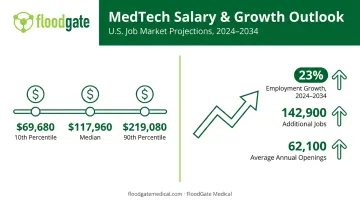
On pay, the BLS reports a May 2024 median salary of $117,960 for medical and health services managers. Earnings vary widely by experience and setting:
- Lowest 10%: under $69,680
- Highest 10%: over $219,080
These figures reflect the broader management occupational category rather than a single standardized "Medical Administrator" title, so actual pay depends on facility size, setting, and scope of responsibility.
The growth outlook is strong. The BLS projects 23% employment growth for this occupational group between 2024 and 2034, translating to roughly 142,900 additional jobs and about 62,100 average annual openings. That's well above average growth for most occupations, driven by an aging population and expanding healthcare access.
Candidates tracking openings and industry shifts in this space can follow FloodGate Medical's newsletter for MedTech hiring trends and career resources.
Frequently Asked Questions
What is a medical administrator?
A medical administrator is a nonclinical professional who manages the administrative and operational side of a healthcare or MedTech facility. They handle scheduling, records, billing, and staff coordination rather than direct patient care.
What are the typical duties in a medical administrator job description?
Core duties include scheduling and records management, billing and insurance processing, compliance oversight (including HIPAA), and supervising administrative or support staff. Specific responsibilities shift based on facility size and type.
What skills are required for a medical administrator?
Employers look for EHR proficiency, billing and coding knowledge, and regulatory compliance understanding alongside strong communication, leadership, and multitasking abilities. Both technical and interpersonal skills matter equally.
What is the salary range for a medical administrator?
According to the Bureau of Labor Statistics, the broader medical and health services manager category earns a median of $117,960 annually, ranging from $69,680 to over $219,080. Actual pay for a specific medical administrator role varies by facility size and scope.
What's the difference between a medical administrator and a healthcare administrator?
Healthcare administrators typically hold broader, organization-wide strategic responsibilities, often at the executive level. Medical administrators generally manage a specific department or facility's daily operations, a narrower scope with less strategic authority.
Do I need a certification to become a medical administrator?
Certification isn't always mandatory, but credentials like the CMAA can strengthen employability and support career advancement. Most certifications require periodic renewal through continuing education, and resources like FloodGate Medical's career coaching can help job seekers decide which credentials fit their target role.
![Medical Scheduler Job Description [Updated for 2026]](https://file-host.link/website/floodgatemedical-yc9tym/assets/blog-images/692cc1a1-aabe-486c-8c34-f627625d633f/1785145458154350_2bcaf2d1c39c43d58f2b1428a008affc/1080.webp)
![Medical Practice Manager Job Description [Updated for 2026]](https://file-host.link/website/floodgatemedical-yc9tym/assets/blog-images/aaa27d1a-a01c-4fb8-b5f3-41b7461ce7f8/1785145357693488_9e5775b277a243ac90b133a686093465/1080.webp)