Introduction
Walk into any clinic in 2026 and you'll see medical assistants doing far more than taking vitals and rooming patients. They're toggling between EHR screens, prepping patients for telehealth visits, and managing patient loads that keep climbing. Many clinics now expect one MA to handle work that used to take two people.
That creates a real problem for job seekers and hiring managers alike: how do you tell the difference between an MA who checks boxes and one who's genuinely job-ready? The skills gap isn't always obvious on a resume.
This guide breaks down the 10 clinical skills that matter most right now, grouped into three practical skill sets: hands-on fundamentals, technology and procedural know-how, and human-centered judgment. Master these skills, and you become exactly the clinically trained talent that MedTech companies and healthcare employers actively seek for clinical specialist and support roles.
Key Takeaways
- The 10 essential skills split into three buckets: clinical fundamentals, tech/procedural skills, and critical thinking
- MA employment is projected to grow 12% through 2034, outpacing most occupations, per the Bureau of Labor Statistics
- Employers now weigh communication and judgment as heavily as technical accuracy
- Certification and continuous skill-building drive long-term career mobility
Core Skill Set #1: Hands-On Clinical Fundamentals
These are the tasks patients notice first, and the ones that build (or break) trust in your competence.
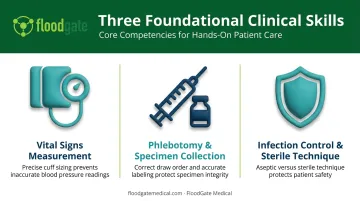
Accurate Vital Signs Measurement
Precise vitals catch problems before they become emergencies. A blood pressure reading off by even a few points can mean the difference between "monitor and reassess" and "call the physician now."
Cuff size matters more than most people realize. A 2023 JAMA Internal Medicine study found that using a regular-size cuff on a patient who needed an extra-large cuff inflated systolic readings by 19.5 mm Hg on average, enough to trigger a false hypertension diagnosis.
What separates a confident MA from a novice:
- Selecting the correct cuff size for arm circumference every time, not just when convenient
- Double-checking automated readings manually when a result looks off
- Watching respiratory rate and oxygen saturation trends, not just single readings
- Documenting vitals immediately, before the next task pulls focus
Inaccurate vitals don't just skew one chart entry. They can delay diagnosis or mask a real emergency.
Phlebotomy & Specimen Collection
Drawing blood looks simple until you're facing a needle-phobic patient with hard-to-find veins and a full waiting room. Solid venipuncture and capillary puncture skills mean:
- Locating viable veins quickly, including on pediatric, elderly, or dehydrated patients
- Staying calm and talking a nervous patient through the draw
- Choosing the right tube and draw order for the ordered tests
- Labeling specimens correctly at the bedside, not "in a minute"
A mislabeled tube or a sample left too long before transport means a redraw, a delayed diagnosis, or a lab result nobody trusts. Done right, specimen handling goes unnoticed. Done wrong, it costs time, money, and trust.
Infection Control & Sterile Technique
On any given day, the CDC estimates that 1 in 38 U.S. patients has at least one healthcare-associated infection. That figure reflects the entire healthcare system rather than any single role. It's still a clear reason sterile technique deserves consistent attention from every MA.
MAs need to apply the right technique to the right task:
- Aseptic technique for routine tasks like injections and wound checks
- True sterile technique for anything involving an open wound or invasive procedure
- Correct PPE selection and removal sequence for each encounter
- Biohazard disposal that follows protocol, not habit
Exam room turnover cleaning gets overlooked constantly, but it's often the last line of defense between patients.
Core Skill Set #2: Technology-Driven & Procedural Skills
Modern MAs need procedural precision and digital fluency to keep clinics running.
Medication Administration
The "rights" of medication administration exist because rushing this step is where things go wrong: right patient, right medication, right dose, right route, right time.
Administration nuances vary by route:
- Oral — confirm allergies and swallowing ability, not just hand over a pill cup
- Topical — correct site prep and application technique
- Injectable — precise site, angle, and technique, plus calming a nervous patient mid-injection
MAs who master this skill notice when something doesn't add up, like a dose that seems unusually high, before it becomes a problem.
Electronic Health Records (EHR) Management
Charting is now real-time documentation that providers rely on mid-visit, not paperwork handled later. EHR proficiency now includes:
- Real-time charting during the visit, not hours later from memory
- Patient portal support, including message triage
- HIPAA-compliant data handling across every digital touchpoint
An MA who's slow or sloppy in the EHR doesn't just create extra work for themselves. They slow the whole clinic's workflow. Hiring managers now watch closely for this skill during MA interviews.
Assisting With Examinations & Procedures
Good exam assisting means staying one step ahead of the provider:
- Prepping instruments and the room before the provider walks in
- Positioning patients correctly and comfortably for the specific exam
- Documenting findings accurately in real time
- Delivering clear post-procedure instructions patients actually understand
Handing someone a printed sheet isn't the same as confirming they understood their wound care instructions before they leave.
Basic Clinical Procedures (EKG, Urinalysis, Wound Care)
A handful of routine procedures separate a well-rounded MA from one who needs constant supervision:
- EKG lead placement accuracy — misplaced leads produce misleading tracings
- Urinalysis handling timelines — samples degrade fast, and timing errors skew results
- Suture removal and dressing changes — attention to healing signs, not just rote technique
- Height, weight, and BMI measurement — directly influences medication dosing, especially for pediatric and weight-based prescriptions
None of these are flashy skills. They're the ones providers assume an MA already has locked down.
Core Skill Set #3: Human-Centered & Critical Thinking Skills
Technical skill gets you in the door. Judgment and communication are what keep providers trusting you with more responsibility.
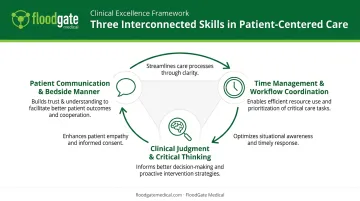
Patient Communication & Bedside Manner
The best clinical skills fall flat if patients don't trust the person delivering them. Adjusting communication style to a patient's anxiety level builds that trust. Sometimes that means slowing down for someone scared of needles; other times, it means being direct with someone who wants facts fast.
Patient-centered communication research links this approach to higher patient satisfaction and stronger treatment adherence, often citing the patient-provider relationship as the strongest predictor of outcomes.
In practice, that looks like:
- Explaining what you're doing before you do it, especially during procedures
- Using teach-back to confirm patients actually understood instructions
- Reading body language, not just the words a patient says
Time Management & Workflow Coordination
That trust has to hold up under pressure, though, since high-volume clinics don't wait for one task to finish before the next starts. MAs juggle rooming a new patient, finishing a chart note, and prepping for a procedure, often within the same ten minutes.
Strong workflow coordination looks like:
- Batching similar tasks, like intake questions, instead of starting from scratch each time
- Communicating status updates so nobody's guessing what's ready
- Anticipating the next step instead of reacting to it
Get this right, and patient wait times drop—one of the biggest drivers of patient satisfaction scores.
Clinical Judgment & Critical Thinking
This is the skill that ties everything else together. A "normal-looking" vital sign that doesn't match how a patient actually looks is one red flag. Catching subtle confusion in an elderly patient and escalating it appropriately is another, and it's what separates a technician from a clinician.
Supervising providers often say this is the quality they trust most when deciding how much responsibility to hand off. An MA who catches small problems early earns more autonomy and stronger references.
Why These Skills Matter More Than Ever in 2026
Telehealth isn't a pandemic-era exception anymore. It's a permanent fixture of primary and specialty care, and that changes what MAs are expected to do:
- Prepping patients for virtual visits, including tech checks and pre-visit forms
- Managing documentation differently when a provider is examining a patient through a screen
- Coordinating handoffs between in-person and virtual care without dropping information
Digital diagnostic tools and AI-assisted charting are showing up in more clinics every year. Ambient AI scribes, for example, can save clinicians several minutes per patient encounter, but someone still has to review the output and catch errors. That review often falls to the MA.
Patient expectations have shifted too. People are used to fast, transparent digital service everywhere else, and they bring that expectation into healthcare.
Long waits and unclear communication push patients toward providers who offer better access and clearer information. MAs sit right in the middle of that experience, often as the first and last person a patient interacts with during a visit.
None of this replaces the fundamentals. It just means the fundamentals now come bundled with a layer of digital fluency that wasn't optional five years ago.
Turning Clinical Skills into Career (and Hiring) Success
For job-seeking MAs, mastering these 10 skills is only half the battle. The other half is showing them clearly on a resume and in an interview.
Practical ways to document your skills:
- List specific procedures and volumes, not just job duties (for example, "performed 40+ venipunctures weekly" instead of "assisted with blood draws")
- Call out specialty exposure, such as dermatology, pediatrics, orthopedics, or device-support experience
- Name your EHR systems and describe your comfort level with telehealth workflows
- Prepare specific examples of clinical judgment calls for interviews, not just a list of tasks
Specialty exposure matters more than most MAs realize. Clinical backgrounds in areas like cardiology, orthopedics, or critical care are increasingly valuable outside traditional clinics, particularly in the MedTech industry. Device manufacturers and healthcare technology companies need people who understand both patient care and the equipment side of medicine, and that combination is rare.
FloodGate Medical fills that gap directly. As a recruitment firm focused exclusively on the MedTech industry, FloodGate Medical connects clinically trained professionals with device manufacturers and healthcare technology employers. The firm also helps those companies build diverse, well-rounded clinical teams through a recruitment approach centered on equity, diversity, and inclusion.

For MAs looking to bridge patient care with the technology side of healthcare, that's a genuinely different career path than a traditional clinic role. Candidates can also stay current on evolving skill demands and job openings through FloodGate Medical's monthly newsletter, which shares ongoing industry insights and career resources.
Frequently Asked Questions
What clinical skills do medical assistants perform?
Medical assistants handle a mix of hands-on tasks, such as vital signs, phlebotomy, EKGs, and medication administration, alongside EHR charting and patient communication. The best MAs combine technical accuracy with strong interpersonal judgment.
What is the most important clinical skill for medical assistants in 2026?
Clinical judgment and communication typically rank highest, since they influence the safety and quality of every other task an MA performs. Technical skills matter, but judgment catches the errors technical skills alone would miss.
How is technology changing the clinical skills medical assistants need?
EHR systems, telehealth prep, and AI-assisted charting tools are now core requirements for the role. MAs increasingly need digital fluency alongside traditional hands-on competencies.
Do medical assistants need certification to perform these clinical skills?
Certification requirements vary by state and employer, and most states don't legally require it. That said, employers increasingly prefer or require certification like CMA, RMA, or CCMA when hiring.
How can medical assistants keep their clinical skills current after certification?
Continuing education, on-the-job practice, and staying updated on new healthcare technology all help. Most certifying bodies also require ongoing CE credits to maintain active certification status.
What clinical skills do MedTech and healthcare employers prioritize when hiring medical assistants?
Employers look for a blend of technical precision, EHR and digital fluency, and strong communication skills. Specialized recruiters like FloodGate Medical help match candidates with these skill sets to the right MedTech roles.