Hiring managers reviewing a stack of applications aren't reading closely. One widely cited eye-tracking study by TheLadders found recruiters spend roughly 7.4 seconds on an initial resume scan, which means most candidates blur together fast. A business degree and "strong communication skills" won't separate you from anyone else in the pile.
This guide breaks down exactly what makes a medical device sales resume land an interview instead of a rejection email, from the bullet points to the formatting to what a specialized recruiter can do that a resume alone cannot.
Key Takeaways
- Quantified results and industry-specific language separate real candidates from generic applicants
- Clean ATS formatting matters as much as strong content — unreadable resumes never reach a recruiter
- Nursing, athletics, pharma, and retail backgrounds all translate into device sales credibility
- A MedTech-focused recruiter puts your resume directly in front of a hiring manager, no ATS required
What Actually Gets a Medical Device Sales Resume Noticed
Hiring managers in this space see hundreds of similar-looking resumes every week, most following the same template layout with generic soft-skill buzzwords and vague job duties. What breaks through is specificity: concrete numbers, named procedures, and evidence that you understand the clinical environment you're selling into.
Lead With Quantifiable Achievements
Vague statements don't survive a 7-second scan. Metrics do.
Weak: "Responsible for growing territory sales and maintaining client relationships."
Strong: "Grew territory revenue by 34% year-over-year, exceeding quota for 6 consecutive quarters while retaining 95% of existing accounts."
You don't need prior sales experience to quantify results. Any performance-based role can be converted:
- Personal trainer → "Built and retained a client roster of 40+ members, generating $85,000 in annual session revenue through referral-based growth"
- Retail associate → "Ranked top 3 of 22 associates in monthly sales conversion, consistently exceeding upsell targets by 20%"
- Food service → "Managed inventory and vendor relationships for a location generating $1.2M in annual revenue"
Reframe Transferable Experience as Sales & Clinical Credibility
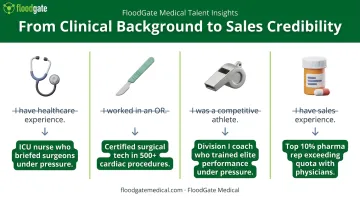
Nurses, surgical techs, athletes, and pharma reps often undersell themselves because they don't realize their background already speaks the language of the OR. The fix is naming specifics, not generalities.
- Nurse/ICU: "Managed post-op care for cardiac patients, collaborating directly with interventional cardiologists on device selection and complication management"
- Surgical tech: "Assisted in 200+ orthopedic procedures, maintaining sterile field and coordinating instrument flow between surgeon and OR staff"
- Athlete/coach: "Led a Division I team through high-pressure competition, developing resilience and performance-under-scrutiny directly applicable to physician-facing sales cycles"
- Pharma rep: "Built and maintained relationships with 50+ prescribing physicians, achieving top-decile call volume and formulary wins"
Say "TAVR procedures," "cath lab," or "CTO devices" instead of "medical settings." Specificity is what signals you've actually spent time around the clinical work, not just researched it.
Showcase Relevant Training, Certifications & Clinical Exposure
Cadaver lab hours, OR shadowing, and product certifications matter for more than appearances: they prove you can function in a sterile environment on day one. That matters because device reps are frequently embedded in live cases. A 2021 peer-reviewed article in the AMA Journal of Ethics confirms representatives are regularly present during surgery to provide technical support and answer procedural questions.
Put this near the top of your resume, not buried under "Additional Information." A clean format looks like this:
Clinical & Product Training
- Completed 40-hour cadaver lab: coronary and peripheral vascular anatomy (2024)
- OR shadowing: 15+ hours observing PCI and CTO procedures
- Certified in aseptic technique and bloodborne pathogen protocols
Structure Your Resume to Pass ATS and Impress Recruiters
Content only matters if a human actually sees it. Jobscan's 2025 research found that applicant tracking systems are in use at 97.8% (489 of 500) Fortune 500 companies, meaning most large employers filter resumes through software before a recruiter ever opens one. This structure functions as a gate that determines whether a recruiter ever sees the resume.
Write a Professional Summary, Not an Objective
Objective statements describe what you want. A summary proves what you offer.
Weak (objective): "Seeking a medical device sales position where I can utilize my skills and grow professionally."
Strong (summary): "Results-driven sales professional with 3 years in B2B territory management, consistently exceeding quota by 15%+. Combines clinical exposure from cardiac OR shadowing with proven consultative selling to build trust with physicians and procurement teams."
Optimize Formatting & Keywords for ATS
Parsing errors can kill applications before anyone reads them. Keep formatting simple:
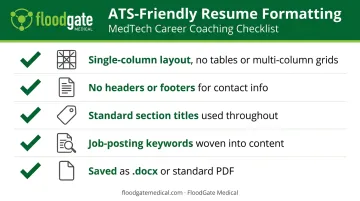
- Use a single-column layout: no tables, text boxes, or graphics
- Skip headers/footers for contact info; ATS software often can't read them
- Use standard section titles: "Work Experience," "Education," "Skills"
- Weave in terms straight from the job posting, such as "OR," "surgical," "physician relationships," or "quota attainment"
- Save as a .docx or standard PDF, not an image-based file
Build a Skills Section That Covers Hard and Soft Skills
A skills section gives ATS software more keywords to match and gives a hiring manager a fast scan point.
Hard skills: CRM software (Salesforce), sterile technique, anatomy terminology, medical device regulations, territory planning
Soft skills: Relationship building, consultative selling, territory management, physician communication
Keep experience bullets to 2-4 per role. Every bullet should describe an achievement, not a duty. Use verbs like "grew," "exceeded," and "reduced" instead of "responsible for."
Common Resume Mistakes That Cost You the Interview
Small missteps disqualify strong candidates before a recruiter reads past the first section.
- Being too generic. "Worked with medical professionals" tells a hiring manager nothing. Try: "Partnered with 12 interventional cardiologists across a 3-hospital territory on device in-servicing."
- Burying certifications. Cadaver lab hours and product training buried under "Additional Information" near the bottom get skipped. Move clinical credentials near the top, right under your summary.
- Clinging to outdated conventions. Objective statements, "references available upon request," and two-page resumes for early-career candidates all signal you haven't updated your approach in a decade.
One page is standard until you've built 10+ years of relevant experience. Use that space for proof, not filler.
Tailor Your Resume for Every Application
The strongest candidates keep a comprehensive master resume — every achievement, certification, and role they've ever held — then build a trimmed, targeted version for each application.
Career centers and MedTech-focused recruiters, including those at FloodGate Medical, consistently recommend this approach: match your resume's emphasis to what the specific job posting values most, rather than sending an identical document to every opening.
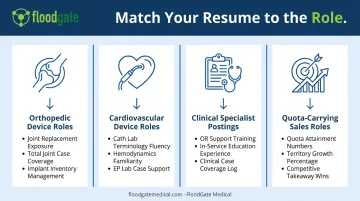
Example adjustments:
- Orthopedic device roles: Lead with joint replacement or trauma exposure to show clinical fit
- Cardiovascular device roles: Emphasize cath lab or interventional cardiology terms, referencing devices like microcatheters or CTO tools
- Clinical specialist postings: Put OR support and technical training front and center
- Quota-carrying sales roles: Lead with quota attainment and revenue growth numbers
Ten minutes spent reordering bullets to match a job description's language is often the difference between passing ATS and getting filtered out.
Why Partnering With a Specialized MedTech Recruiter Changes the Game
Why a Specialized MedTech Recruiter Gives You an Edge
A polished resume earns you a spot in the applicant pool. It doesn't guarantee a human ever opens it. That's where a recruiter who works exclusively in MedTech changes the equation: they can hand your resume directly to a hiring manager, skipping ATS filtering entirely.
FloodGate Medical operates this way, built around relationships with hiring managers rather than job-board submissions. A few things worth knowing:
- Advocates for candidates from non-traditional paths through equity-driven programs, including Futures for Veterans for military transitions and Breaking Into MedTech for career changers
- Provides resume guidance and interview prep through FloodGate Futures career coaching, helping candidates highlight the strongest parts of their work history
- Offers ongoing resources, including career-tips content and a two-part interview series with FloodGate's CEO, to help candidates keep refining their materials beyond a single application
If you're rebuilding a resume from a non-traditional background, a recruiter who already knows which hiring managers value that background can matter more than any formatting tweak.
Frequently Asked Questions
What are the 5 P's of a resume?
One commonly referenced framework describes Positioning, Personal Branding, Pitch, Presentation, and Professionalism. It's not an industry-wide standard, but it's a useful checklist for making sure your resume communicates clear value, not just history.
How long should a medical device sales resume be?
One page is standard for candidates with under 10 years of experience. Keep bullets concise and achievement-focused rather than padding length with duty descriptions.
Should I include a professional summary or an objective statement on my resume?
Use a professional summary. Objective statements describe what you want; a summary proves what you offer in 2-3 sentences, which is far more persuasive to a hiring manager.
How can I get my medical device sales resume past the ATS?
Use a single-column layout, standard section headers, and keywords pulled directly from the job posting. Avoid tables, graphics, and text boxes, which many parsers can't read correctly.
What if I don't have direct medical device sales experience?
Reframe transferable skills from nursing, retail, athletics, or pharma into clinical language, and pursue cadaver lab hours or OR shadowing to build credibility. Specificity about procedures beats years of titled sales experience.
Can working with a recruiter improve my chances of getting an interview?
Yes. Firms like FloodGate Medical specialize in MedTech placements and have existing relationships with hiring managers, letting them present your resume directly and bypass ATS filtering that might otherwise screen you out.